A character from an author's comic
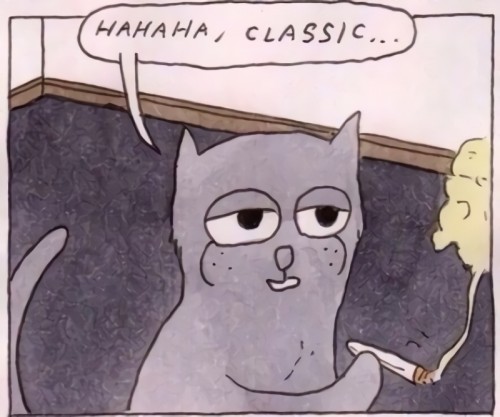
The black cat in the image is Mogg, a character from the comic by Australian artist Simon Hanselmann. He belongs to the company of Megg and Owl. The series combines crude comedy with heavy themes, including poverty and depression. The collection Megahex came out in 2014 and gathered earlier stories; the comic existed online before the book edition. Poverty and depression set the series' overall tone, but the excerpted episode leaves only a short line addressed to the interlocutor on the right.
An independent reaction formed around the frame where Mogg smokes and says “HAHAHA, CLASSIC…”. In Russian-speaking communities, the image was used from about 2016, when it began to be posted in response to familiar absurdity.
Tired recognition
There is laughter in the line, but Mogg does not look cheerful. Drooping eyelids and the short “classic” give the words a dry tone: a familiar absurdity has recurred, and the character notes it almost automatically. It is precisely the mismatch between the cheerful phrase and the unimpressed face that sets the reaction.
Such a response fits when the audience already knows a recurring pattern: for example, a build breaks again after an update, or an acquaintance is late once more. For a first unexpected event, the word “classic” does not give this sense of recognition.
From a comic scene to a reaction
In the original comic, Mogg is a participant in relationships and jokes inside Hanselmann's story, not a standalone reaction symbol. The meme cuts a short moment out of a longer scene: the panel still shows the profile of the interlocutor, and the direction of the speech bubble ties the reaction to the line opposite, without turning it into a universal assessment of any event.
The frame holds two intonations at once. The cigarette and half-closed eyes recall the comic character, while the speech bubble turns his laughter into a line addressed to an interlocutor. When moved into messaging, that interlocutor may disappear, and the place of the conversation is taken by the preceding message: for example, another promise of “I'll be out in five minutes.”
Without a recurring situation, the English word remains just an evaluation of “classic,” not a reaction to absurdity. That is why the caption usually names the familiar cause of recognition — a glitch or a habit; the original comic context gives way to a short message before the picture.
Examples of new captions
Example: “The build passed green, but after launch it crashed again on the font — hahaha, classic.” The point is not any failure, but a familiar repeat the team has already seen.
Example: “He wrote ‘leaving in five minutes’ an hour ago — hahaha, classic.” Here the phrase expresses recognition: friends understand that the delay is recurring.
Example: “We agreed not to order dessert at first, then ordered two — hahaha, classic.” It is an innocent habit, and the caption notes a familiar turn without any serious complaint.