The story of the bet
According to the description, the episode is connected to a Dota 2 tournament where player Alexei “Solo” Berezin placed a bet against his own team. The sum that gave the meme its name was 322 dollars. According to the catalog, he did not receive the winnings and was then disqualified for a year for deliberately losing the match. The organizers' official decisions are not quoted in this entry, so the details should be taken as a retelling rather than a court document.
Even in this shortened form, the story is telling for esports. Bets on matches in which the player himself takes part are almost always banned by the rules, because they create a direct conflict of interest. Violating such rules is taken very seriously in the professional environment, so disqualification was a predictable outcome.
What “throwing” means
In esports viewer circles, “throwing” (the Russian term “слив”) means a deliberate loss, behind which stands a deal or a betting scheme. The term has long been established in discussions, and any episode with a suspicion of breaking fair play quickly gets the label. In the case behind the meme, the issue is exactly this: the player bet on his own team's defeat, and the scenario immediately became a subject of dispute.
It is important to distinguish the term itself from a specific episode. “Throwing” as a concept describes suspicious behavior, while a particular situation must be confirmed by the organizers' decision or official materials. The catalog's description rests on the fact of the disqualification, and that is its main support.
The image and the meme
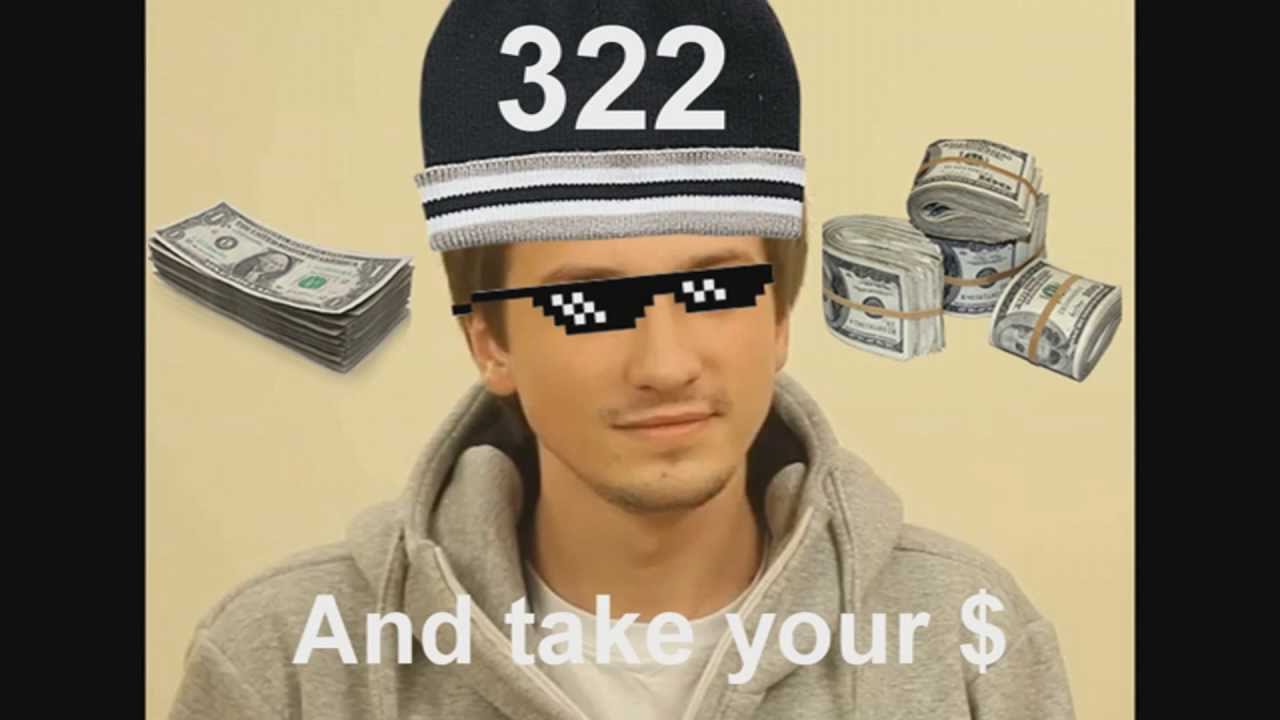
The picture the entry uses is built on a template. It shows a young man in a black cap with the number “322” on it, wearing pixelated glasses against a backdrop of stacks of dollar bills. Across the bottom, in large type, it reads “And take your $”. This template recalls popular macros with pixel glasses, where pairing money with a self-assured pose turns any situation into a joke.
In this template the number on the cap works as a key: change the sum and the meme starts discussing a new episode. Examples of captions from this series: “322 — and take your money, which won't be there” and “Bet on your own team: the sum is small, but the suspension is a full year.” Both captions poke fun at the betting scheme itself rather than at the player's personality, which matches how the meme is used in the community.
Community reaction
The 322-dollar episode became an example of how the esports community reacts to suspicion of match-fixing. Viewers quickly assembled a meme from a recognizable template, and the discussion shifted from the specific sum to the question of how strictly such violations should be punished. For many, it was a reminder of how important transparent rules are for players and organizers.
The meme should not be read as a verdict on the individual, however. It records an event that has already received a public disqualification decision and reflects the community's interest in fair competition. This framing is more accurate than any judgment of the person or his motives.
What is known and what isn't
The entry contains no date for the tournament, no team name, no exact term, and no links to the organizers' decision. It does not say who first made the image or in which community it became popular. These gaps make it impossible to verify every detail, so the article relies on the catalog's version and on general esports rules.
For the reader it is important to understand the difference between a fact confirmed by an official decision and a meme that retells the event in simplified form. From the description it follows that a bet was placed, the winnings were not paid, and a one-year disqualification followed. Other details require separate confirmation.