What is visible in the frame
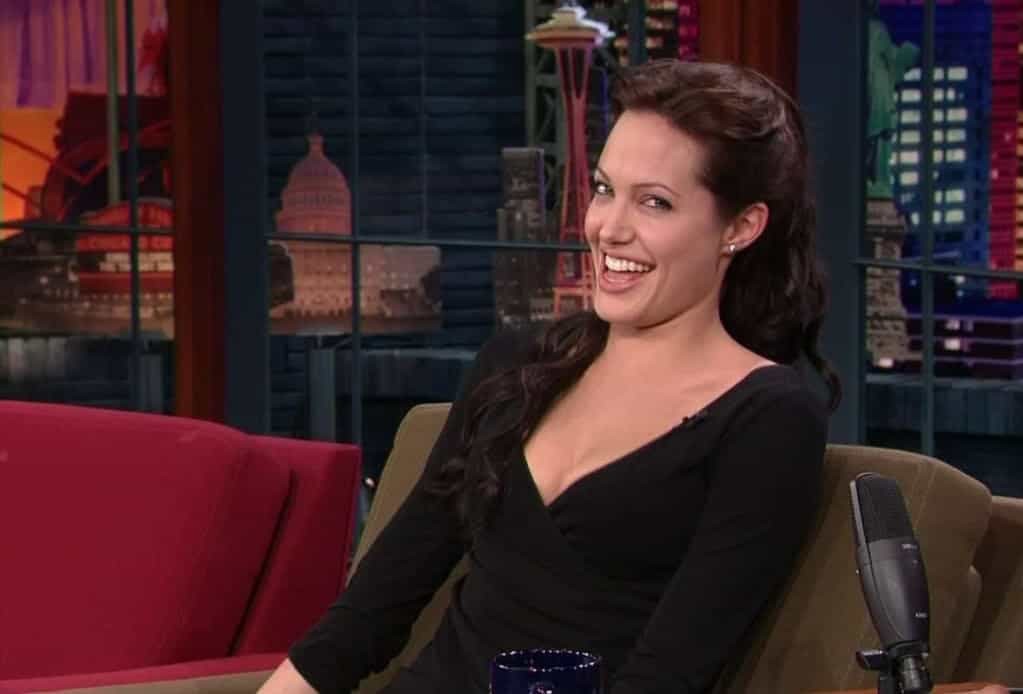
Angelina Jolie sits on a couch in a dark wrap dress, her hair partly pulled back. She has turned her head toward the camera, smiling broadly and laughing, eyes narrowed. The laughter looks spontaneous: her mouth is open, her shoulders relaxed, and there is no posed “beautiful smile.”
Behind the actress is a city backdrop with recognizable silhouettes: the Space Needle, the Capitol building, the Statue of Liberty. A red couch is visible on the left; on the right, by the backrest, a studio microphone stands; in the foreground, a blue mug. The setting resembles the set of an evening talk show, but the exact show and recording date cannot be determined from the frame itself.
What is known about the origin
This is a screenshot from a television conversation, not a specially shot portrait. It has not been possible to reliably establish which episode, and in what year, served as the source: the frame has long circulated online without a caption, and Jolie has given many interviews on American television.
So it is more honest not to attribute a specific joke or conversation topic to the meme. The frame does not reveal what the actress is laughing at, and that is exactly what makes it convenient: the viewer supplies the reason themselves. The picture does not prove the heroine's real mood at the moment of filming, but it looks like genuine amusement.
Why the frame works as a reaction
The main strength of the shot is that the laughter in it is not mean. It does not mock the interlocutor and does not look sarcastic, so the caption acquires a tone of “I genuinely find this funny.” The slight turn of the head toward the camera creates the effect of the actress sharing a joke personally with the viewer.
The second device is the contrast of status and emotion. A Hollywood star on a TV screen usually looks composed, but here she laughs without restraint. A caption describing a very small, everyday reason receives a comic exaggeration: a trifle provokes a reaction of global scale.
Caption examples
“Colleague: ‘Let's skip the unnecessary meetings.’ Me, remembering the twenty-fifth meeting this week.” The joke is built on the intersection of words and experience: the phrase sounds like hope, while the laughter betrays skepticism.
“Friend in the chat: ‘I'm definitely going to make the deadline.’” A short line and an immediate reaction work like a pause before the punchline.
“Mom: ‘I won't cook for the whole family a week in advance anymore.’” The reaction fits promises no one believes.
“When a photo caption has a hundred likes and the comments say only one word: ‘haha.’” Here the laughter emphasizes the absurdity of the situation, not malice.
What sets the frame apart from similar reactions
Among reactions with laughing celebrities, this frame stands out for its gentleness. There is no mocking grimace, no closed eyes or head thrown back as in many “laughing” pictures. The actress looks straight into the camera, and her gaze stays warm. That is why the caption reads as a personal confession rather than mockery of the interlocutor. It is worth remembering when choosing a caption: the kinder the occasion, the more organic the template looks. If the occasion is too sharp, the light smile in the picture will argue with the text, and the joke will lose its coherence. The horizontal format of the frame pairs well with a short line on top and a second line below.
How to use the template
The frame works best where good-natured laughter is needed: under friends' jokes, funny messages, unexpected turns in a discussion. For biting arguments it is less suitable: an open smile softens any remark and may look like mockery of a living person if the caption implies it.
The caption should be short, one line above or below the picture. Extra text drowns out the facial expression, and the expression here is the whole joke. The format “situation — reaction” works well, with the first part describing something deliberately absurd.