What this version shows
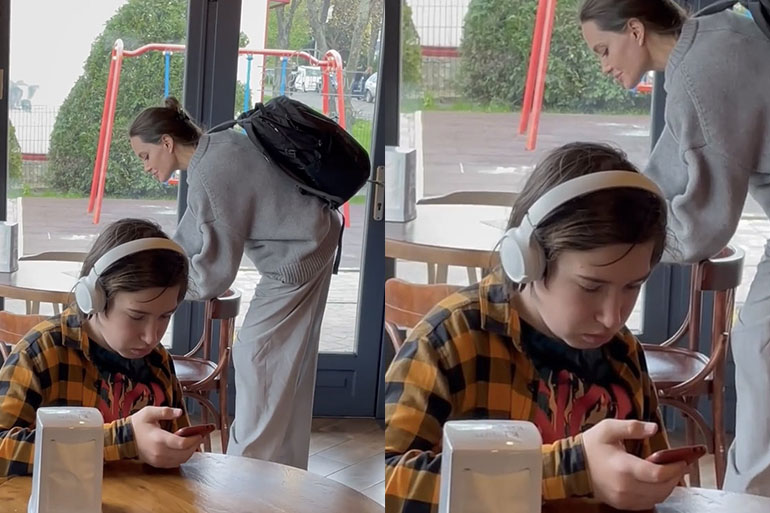
The image is a diptych of two frames from a computer-generated scene. A child wearing large headphones sits at a table looking at a phone; an adult woman leans toward him, with a playground visible in the background. This is not a photo of Angelina Jolie, but a stylized depiction of the situation "someone fails to notice what's happening nearby." The title refers to another well-known version of the meme, in which a person fails to notice a celebrity; this particular picture may be a later redraw, or the image may simply not match its title.
The motif that outlives the swapped picture
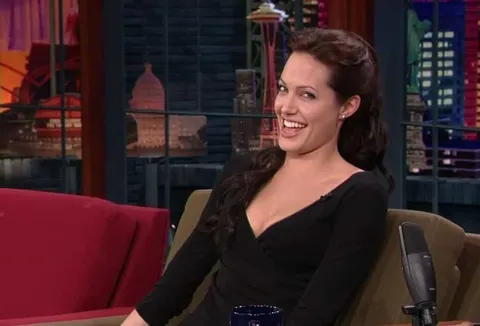
The core structure of the meme is conspicuous inattention. One participant or event is right there, but the subject keeps doing their own thing. Visually, this is easy to convey with headphones, a gaze fixed on a screen, or a closed-off posture. The well-known Angelina Jolie version uses the contrast between a world-famous star and an ordinary passerby who supposedly doesn't react to her presence. But this picture shows a different scene; it shouldn't be credited with a real biographical episode, nor should the woman in it be claimed to be Jolie herself.
Why the comparison works
The viewer expects an unusual event to provoke a reaction and instead sees focus fixed on something trivial. The bigger the gap in scale, the stronger the comedy: something important, beautiful, or rare is happening nearby, while the subject is absorbed in a notification, a game, or searching for music. The two nearly identical frames reinforce the sense of immersion: the situation repeats, but the attention is still absent. This template can speak to either absent-mindedness or deliberate ignoring; the caption needs to clarify which idea the author intends.
Example captions
"When they brought the cake into the room, and you're trying to finish your daily task." "Your parents call you to dinner for the third time while you're picking which meme to send." "The whole team is discussing the deadline; I'm investigating why the cursor changes shape." These versions use the structure of inattention without claiming that the child in the original hears those specific words. For a sharper joke, the caption can split the frames into "what's happening around" and "what's occupying the subject."
How to distinguish between versions
The simplest way to clear up the confusion is right in the caption of the post: note that it's "a 3D scene of a child in headphones looking at a phone, with an adult nearby and a playground in the background," and leave the reference to Jolie only as an explanation of where the title came from, not a description of the picture itself. The shared motif of inattention holds in both versions, but the visual technique and composition differ enough that mixing them into one caption isn't advisable.
This picture can be used for a joke about not hearing a call to go for a walk until you finish a game: the contrast between an adult waiting for a reaction and a child still staring at the screen preserves the meme's general motif. The topic's popularity came from the contrast between a celebrity and an indifferent onlooker, not from reliable information about what actually happened in the café. So it's better to describe the two separately, with an explicit note about the mismatch between the title and the picture.