Shouting on the left, composure on the right
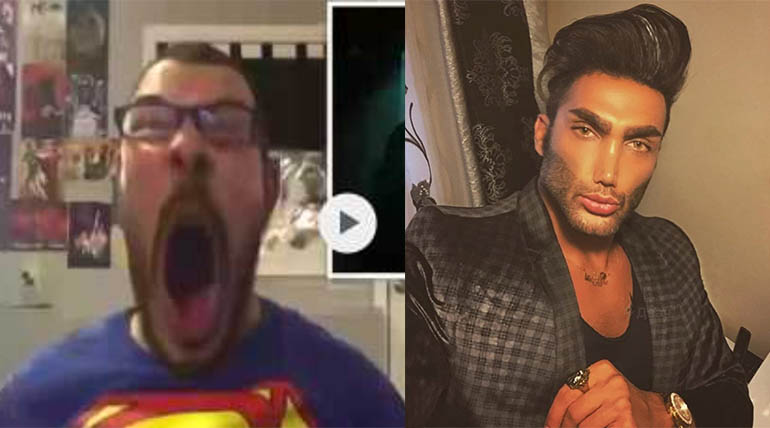
The image is assembled from two parts. On the left is a still from a video: a man in glasses and with a beard has thrown his head back and opened his mouth wide; he wears a blue shirt with a Superman-style emblem, and behind him is a wall of posters. A play button sits in the middle between the halves, as if it were the preview of a clip. On the right is a studio-style portrait: a man with a tall, combed-back hairstyle, expressive eyebrows and stubble, in a checked jacket, with a ring and a watch on his wrist. His gaze is calm and slightly superior.
The contrast works on every level at once: noise against silence, a messy home shot against a deliberate pose, an emotional outburst against restraint. This gap carries the joke; the caption only says what the argument is about.
Where the two halves came from
The left half is a frame from a YouTuber's video, and the right half is a widely shared photo of an Iranian blogger. The names of the people in the pictures are not needed for the joke, so they are not given here. These are two separate images that were combined into one template with the question “who is who”.
The earliest combination found dates to 30 September 2019: a post on Twitter labelled the left side as someone passionate about space travel and the right side as a flat-Earther. This is an early example that was found, not a proven first post. The template then spread: on 18 October 2019 variants appeared in an anime community on Reddit, in early November 2019 a version about ocean lovers became popular, and in June 2020 a joke about marijuana smokers and bread-and-butter lovers drew a large response. Reportedly, by July 2020 the format had spread across all the major platforms.
It is important not to confuse the template with individual photos: the jokes involve not specific people but the types depicted in the pictures. A caption says nothing about the people themselves.
How the joke reads
The formula is simple: on the left the “fan”, on the right the “enjoyer” of the same thing. The fan shouts, quotes, wears merch and declares the favorite the best in the world. The enjoyer stays quiet and simply knows what is good; they don't need to prove anything. The viewer grasps the hierarchy at once, because the pose on the right reads as more “grown up” and confident.
The template also works in reverse. If the right side is captioned with something absurdly narrow or dull, the composure turns into smugness, and the shouter on the left becomes the most alive of the two. So the joke works both ways, and much depends on what exactly you give the “enjoyer”.
Caption examples
The examples below are invented and do not quote real posts.
Left: “Typical fan of the series”. Right: “Typical enjoyer of the series”. This is the most basic setup: enthusiasm on the left, knowledge on the right, and the caption sets the frame at once.
Left: “Typical lover of whole-bean coffee”. Right: “Typical instant-coffee drinker at 5 a.m.”. The contrast is in scale: a solemn taste against everyday truth, and the sympathy ends up with the modest habit.
Left: “Typical fan of the new app version”. Right: “Typical enjoyer of the old interface”. A joke about nostalgia: the calm half looks like a conscious choice, though it is really a habit.
Left: “Typical fan at the match”. Right: “Typical person who watches the replay without spoilers”. Here the shouting conveys the emotion of the moment, and the composure stands for patience.
Making the template work
Pairs work best when the left side is a widely understood passion and the right side is something subtler or stranger. If both captions are too similar, the contrast disappears and only two pictures remain side by side.
Choose a theme where the viewer recognises both types at once. The more specific the fan's behavior and the more precise the enjoyer's manner, the stronger the effect. Don't caption the right side with the name of a real person, and don't attribute beliefs and habits to the people in the photos: the template is about stereotyped types, not biographies.