A cover about fame and fans
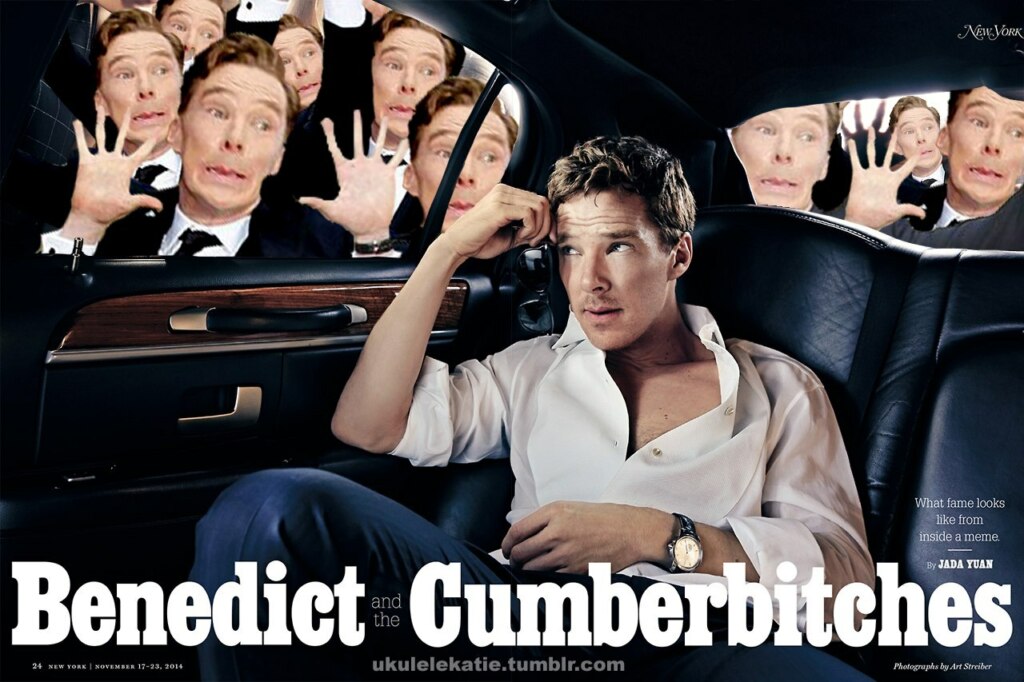
On the cover, Benedict Cumberbatch sits in a car, while several of his faces and gestures seem to surround him in the windows. A large headline names the actor and his fans; a small subhead for the piece hints at how fame looks from inside memes. This is the cover of the November 17–23, 2014 issue of New York Magazine, shot by Art Streiber for a text by Jada Yuan. By that time, the actor, his unusual name, and an active fan audience had already come together in one public story.
From an early pun to a generator
One well-documented early pun appeared in The Washington Post in May 2012: in the second part of a note, the actor's name turned into “Bandersnatch Cummerbund.” Readers first took it for a typo, but the editors clarified that the joke was intentional and came from a participant in a weekly discussion of television programs; the word Bandersnatch also referenced Lewis Carroll. The newspaper joke shows how easily a recognizable name turns into an absurd phrase. In August 2013, a Tumblr user named Wandaventham launched a generator that offered new rhyming variants; from then on, such results could be produced again and again, keeping the rhythm and the recognizable part of the surname.
How the sound gets mixed
A successful twist does not have to be a real pronunciation mistake. It keeps a few familiar sounds, changes the neighboring syllables, and replaces the result with a word that can stand on its own. If the whole name were replaced with a random word, the link to the actor would disappear and only nonsense would remain. In “Bandersnatch Cummerbund,” almost the entire original surname is still recognizable, but its parts recall a fantastical creature and an item of clothing; the unexpected pair sounds like the name of a character from another story. The generator expanded this device: random combinations allowed jokes without any news about the actor at all. The 2014 cover adds another layer: the name's popularity is tied to an audience that exchanges nicknames and images. But these nicknames are better understood as a game with a complicated sound, not as an exact description of Cumberbatch's character or behavior.
Invented variants
For an imaginary poster of a home movie night, one could invent “Benedict Cumber-Baton”: the familiar surname turns into a bread menu item but keeps the rhythm and most of the sound. In a playful announcement, “Benedict Cumberback” would fit, as if the actor invites viewers back to an old series; the last part recalls the English word “back” and creates a second meaning. These are invented forms, not quotations from the generator. In the first case the pun rests on an everyday word; in the second, on a sound-alike with an English expression. If a reworking loses the original name entirely, the reader has nothing to compare the result with; if it keeps the name's rhythm, the new word is immediately recognized as a play on Cumberbatch.