What’s in the dig
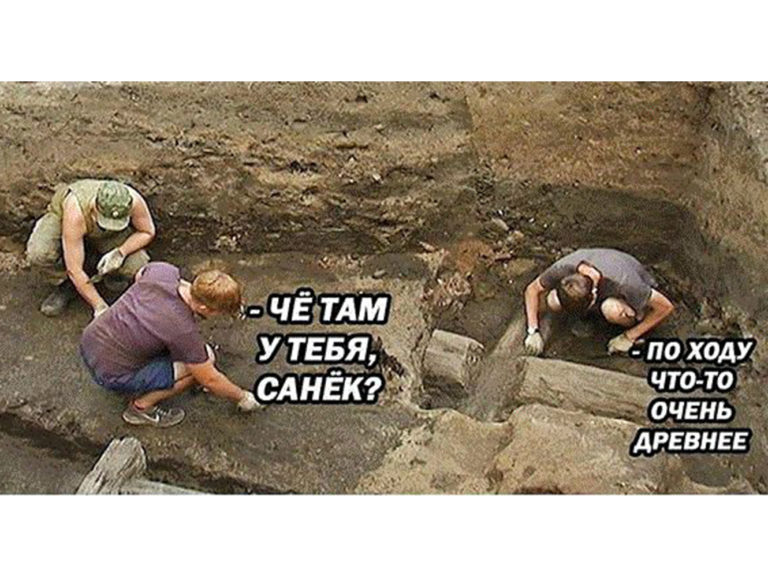
The photo shows a dug-up patch of earth with stones and several people in work clothes. Two are bent over the ground, while a participant in a purple shirt works closer to the viewer. White margins above and below leave the photo visible in the center, and bold letters already form a dialogue: “WHAT’VE YOU GOT THERE, SANYOK?” — “LOOKS LIKE SOMETHING VERY ANCIENT.” The lines sit inside the photograph: the question nearer the center, the answer on the right from the person leaning over the ground. The white areas above and below the image contain no text. The object the archaeologists are discussing is not shown here yet.
In August 2018 the format spread on VKontakte: there were examples featuring Ugandan Knuckles, “Dratuti,” and Upyachka. A review of that time describes a post from the FTP public page on August 4 as an early example: a wide shot of the dig was followed by a close-up of a brush and an inserted meme. Other variants were already noted on August 5 and 6. This sequence shows how quickly the construction spread, but it does not establish the photo’s author or the absolute inventor of the joke.
How the joke about antiquity works
The archaeological setting makes viewers read the object as a rare find, while the word “Sanyok” shifts the scene into a friendly, everyday exchange. The comedy emerges when the second participant in the excavation is the internet, an archive, or someone who dug up an old thing. The “ancient” item might be a meme from a past wave, a forgotten interface, last year’s correspondence, or news everyone already discussed. The point is not scientific dating but the exaggeration of age.
The role of the second frame
In the full construction, the discovery is delayed. First the viewer hears two voices but doesn’t know what has turned up in the ground. Then a photo of the object or old meme takes the place of the find. This is a miniature story with a riddle and an answer; archaeological caution comically raises the value of an ordinary internet picture. If only the wide shot is left, the same mechanism is supported by an external caption naming the artifact. However, the white margins and empty areas of the photo should not be confused with an additional scene: this image has one photographic setup.
The age of a find is always relative. A meme only a few months old can count as ancient in a community with rapid shifts in jokes. For a family album, antiquity is measured in decades; for a work chat, by the previous version of a project. That is why Sanyok acts as a conventional search engine of memory: he digs up what everyone else has forgotten and presents it as a discovery.
Three new digs
In a graduates’ group, you can caption the answer: “Looks like a timetable nobody has updated since first year.” For a family chat, a find like “phone charger from a phone sold ten years ago” fits. In a work project, an archaeologist might discover the “final version of the report before all the edits.” The timetable is funny because studies continue while the document stays frozen at the start; the charger recalls a long-sold phone; the “final” report reveals layers of later corrections. Each object gives its own reason to call the find ancient.
Another find: a folder of photos everyone thought was deleted, which unexpectedly resurfaced on an old drive. In a gaming community, archaeologists might clear the dirt around a long-promised update. These captions keep the original’s question form and let the reader guess for themselves why the object looks prehistoric. It is better to make the answer concrete: the name of an app or object instantly turns the general joke into a recognizable situation.