Children's hero by Bourgeois and Clark
Franklin was created by Canadian writer Paulette Bourgeois and artist Brenda Clark. The first book, Franklin in the Dark, came out in Canada in 1986, and in the US the following year. Later the hero acquired numerous book adventures and a television life. Their familiar world consists of family, friends, and small discoveries: a child recognizes themselves in the turtle, who learns to cope with understandable everyday difficulties.
Parody covers existed at least as early as 2016, and a noticeable wave came in March 2018 in Reddit communities. Among the known participants in this spread was Moonbeam_My_Banshee. Users kept the hero and the recognizable look of a children's book but changed the title of the story. The March wave does not mean that jokes about Franklin were invented then for the first time: alterations of covers and humorous re-dubbings of the cartoon existed before.
A pensive visitor by the cradle
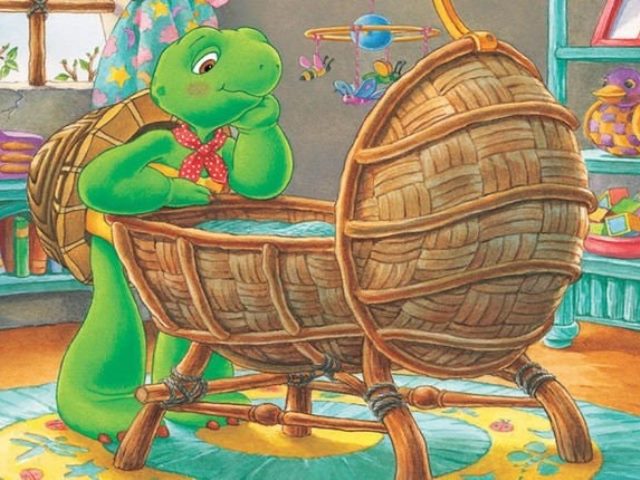
In the illustration, green Franklin stands beside a large woven cradle. He props his cheek with one hand and holds the other near the edge of the cradle. A red tie with white dots is tied around his neck. Around him are toys, a mobile hangs above the cradle, and a bright rug lies underfoot. The baby is not visible; attention is focused on the pensive older character and the object he has stopped beside.
The scene is connected to the book world of Franklin's Baby Sister, a story about waiting for a new sister. But here there is neither the book's title nor the familiar cover frame. Therefore the image reads as an independent situation: the hero has received a new responsibility and is pondering what it means. His gesture can be read as a question, bewilderment, or worry. These nuances come from the pose itself, while the specific reason in the meme version is assigned by the new caption.
When the title changes the genre
Parodies keep the tone of a book for beginning readers: the hero's name, a short action, a promise of a small lesson. But after “Franklin” a problem appears in the title that a children's series usually doesn't discuss, and the adult viewer recognizes their own worry in a softly drawn world. The contrast between the cozy room and the alarming new title creates the joke: the cover looks genuine, but the subject is clearly meant for a different reader.
However, an arbitrary loud caption gives the picture only a weak connection. Here anticipation, supervision, and responsibility for something small are especially expressive. The cradle helps set up these relations, and the hand at the cheek adds reflection instead of immediate action. The new title can keep the scene domestic, or turn it into a metaphor for a project, an order, or a plant. Even a strange story becomes understandable if the image contains a visible reason for its beginning.
Three titles for books that don't exist
“Franklin waits for the courier while all the adults have left.” In this invented story, the hero has suddenly become responsible for household order. The cradle keeps him near home, and the pensive face conveys doubt: how to wait for a delivery and at the same time not miss anything? The childlike title hides a familiar adult task of coordination.
“Franklin agreed to watch over the seedlings and now checks their breathing.” The cradle turns into an exaggeratedly caring place for young plants. The hero treats a simple errand so seriously, as if he had been entrusted with a newborn. What is funny is not the care itself but the literal transfer of ways of caring from one situation to another.
“Franklin learns why the word “a little” is no longer on the shopping list.” Here new family responsibility suddenly changes the scale of ordinary errands. The hero looks at the cradle as if it were an explanation for the growing stock of supplies. The viewer fills in the domestic story from a single gesture, and the calm illustration becomes the cover of a small discovery about change at home.