What the frame shows
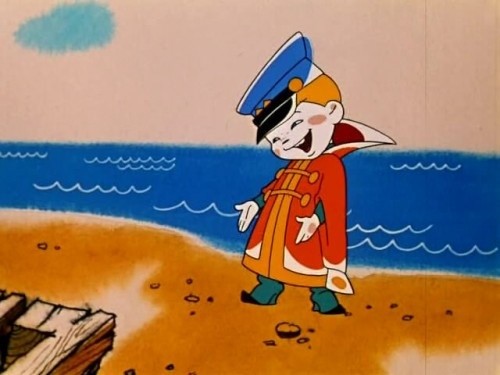
A hand-drawn boy with pink cheeks walks along a sandy beach, laughing broadly with narrowed eyes. He wears an orange-red jacket with a high collar, yellow buttons and white trim, a blue cap with a black visor, and green boots. His arms are slightly spread, and his pose is relaxed and self-satisfied. Behind him is a blue sea with white wave strokes; boards stick out at the bottom left, and pebbles are scattered on the sand.
The style is flat and bright, like many Soviet cartoons, with clean color fills and almost no shading. There is no text in the frame, so the caption is always written by the author of the joke.
The cartoon the phrase comes from
The expression "I tak soydyot" is tied to the cartoon Vovka v Tridevyatom tsarstve, released in 1965 by the Soyuzmultfilm studio; the director was Boris Stepantsev. The schoolboy Vovka dislikes work and ends up in a fairy-tale kingdom, where he meets characters from Russian folk tales, including the Golden Fish and the Tsar. The moral of the film is simple: laziness leads nowhere, and labor is worth more than ready-made miracles.
Which exact scene appears in this frame cannot be determined from the picture itself, so no specific plot details should be attributed to it. For the meme, what matters is not the scene but the hero's general mood: carefree confidence that everything is already fine.
How the phrase lives in speech and online
"I tak soydyot" has long entered everyday speech as a catchphrase used to excuse careless work. The date of the first internet joke with this frame is hard to pin down, and accounts of who first used the picture differ, so it is best not to insist on a specific year or author.
The meaning, however, is stable: indifference to the result, or mockery of someone who did a poor job and thinks that is enough. The smiling boy suits both readings, since there is not a hint of doubt on his face.
Captions that work
"Deadline in an hour, and I put the presentation together like this: good enough." The joke rests on the gap between a serious deadline and the breezy self-assessment.
"A handyman who installed the outlet crooked but smiles with total confidence." The happy face contrasts with the obvious defect, and it is exactly that contrast that is funny.
"Me when I dust only the places that are visible." An everyday trifle becomes a mini-story, and the caption is recognizable without explanation.
"Reviewer: this needs fixing. Me: good enough." A short exchange in which the picture serves as the answer, reading as a refusal to spend effort.
How to use the image
The frame works best next to an image of a failed result: a bad outcome on the left, a pleased boy on the right. That way nothing needs to be explained.
The key choice here is tone. If the caption is written in the hero's own voice, it reads as self-deprecating humor, a safe option for a friendly joke. If it is aimed at someone else's work, it becomes mockery and easily turns into a reproach aimed at a specific person. A joke about general carelessness is almost always funnier than a personal grievance.
Keep the caption short, three or four words: the image is expressive enough on its own, and a long story would only drown it out. A pair of frames also works well: first a "task," then the boy on the beach as the performer's reaction.