What the image shows
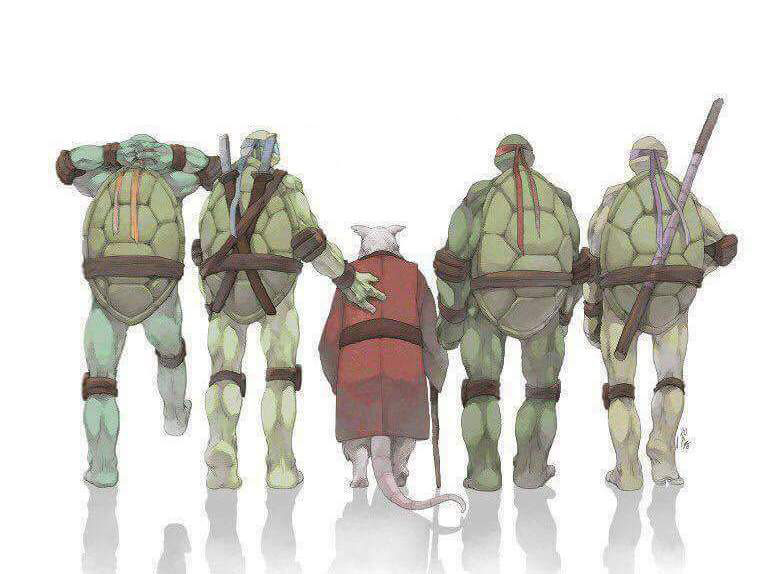
The picture shows four adult turtles and the rat Splinter, seen from behind. Splinter wears a red robe, leans on a staff, and rests one hand on the shoulder of the second turtle from the left. From left to right, the turtles are recognizable as Michelangelo with orange bands, Leonardo with a blue mask and a katana on his back, Raphael with a red mask, and Donatello with a purple band and a bo staff. The figures stand against a pale background with soft reflections, which gives the scene a calm, thoughtful feel. The uploaded file shows only this single scene, without the second half with small turtles that the catalog entry describes. This version, with four adult heroes and an aging mentor, is the one that became the basis for the format.
Where the drawing came from
According to the meme's documented history, the original drawing was posted by the artist puna-nezuki to their Tumblr on January 22, 2017, where it is titled “Father.” The artist depicted the relationship between the heroes and their mentor, which changes over time: the students grow up and the teacher ages. The drawing was made as a fan work based on the Ninja Turtles franchise, not as an official still. Its origin is established, which sets this image apart from many viral pictures whose creators are unknown. The meme itself, meaning the use of the picture with captions, came later. The earliest recorded versions date to January 2018, when the picture was used in jokes about bitcoin on Imgur.
How the format works
The main device here is the captions. The figures in the picture get labels, and the composition itself shows the life cycle of a trend: the small turtles stand for what is new, the adults for what has already passed its peak, and Splinter becomes the figure of the older generation that remembers the beginning. The format has moved from technology to music and philosophy while keeping the same scheme. A sample caption of this kind might read: above the small heroes, “New programming language”; above the adults, “Legacy code nobody touches”; and above Splinter, “The person who wrote it.” The format is convenient because it needs no explanation: the viewer sees four figures and immediately understands that it is about generations.
Spread
After the January versions, the format kept appearing throughout 2018. The meme's documented history records a January 20 version on Imgur about web browsers, along with a later version from December 14 on Reddit in the r/MemeEconomy community, where the picture was used for economic jokes captioned “Giving Wikipedia 3 Dollars.” In this way the format survived its first burst and settled in as a template that suits different topics, from technology and business to personal stories. The spread follows the usual pattern for images of this type: first they are posted on image-sharing sites, then communities pick them up and adapt the captions to their own audiences.
Why the picture works
There are several reasons. First, visual contrast: small and adult figures from the same group read immediately as a difference in time, and no words are needed for that. Second, Splinter is a mentor figure, and in the franchise's story he does teach the heroes, so his presence automatically adds a sense of continuity. Third, the drawing is neutral in tone: it doesn't mock any character and doesn't require knowledge of a specific episode. That is why the picture applies both to generations within a family and to the life cycles of products. The artist used no explicit irony; the irony came later, in community captions, and that is what made the format popular.
What to clarify in the catalog entry
The catalog entry describes two halves of the picture, small and adult turtles, and says the mentor “leads them by the hand.” The uploaded file shows one scene, with Splinter's hand resting on the shoulder of one of the characters. The 2018 date in the tags matches the first recorded uses of the meme, whereas the drawing itself dates from 2017. The reading “continuity of generations” is accurate, but it is more precise to say that this is how viewers read it, not the intent of the author, who titled the work “Father.” This clarification helps separate the drawing itself from the template that grew out of it.