How a pseudo-history became an internet game
In 2023, videos began circulating under the name "Professor Bagirov," telling of an invented past in which the ancient Rus fought lizards, lived alongside dinosaurs, and created an alternative history. The delivery imitated a lecture: a confident voice, bold claims, a pseudo-scientific tone. The mismatch between the look of a serious talk and its incredible content became the basis of the joke.
The professor's name and titles should be seen as part of an internet persona, not as the established biography of a historian. Retellings place the start of the series in videos from spring 2023, but it is hard to identify the exact first video or the author of individual pictures. The main point is that a war with reptiles is not a historical event and is not supported by archaeology or academic research.
Why an absurd legend sounds solemn
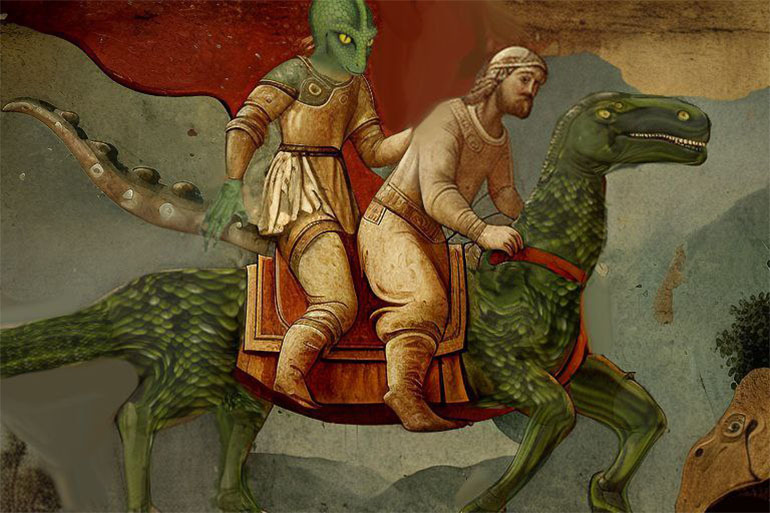
The picture shows people in old-fashioned clothing sitting on long-necked lizards. The scene resembles an episode from a heroic chronicle, although the idea itself makes it a fairy tale. The viewer recognizes a familiar image of the past, with riders, weapons, and a campaign, and at the same time sees an impossible companion. The serious composition seems to prove something that never happened.
The meme suits an absurd alternative chronicle and jokes about how a confident delivery can lend weight to fiction. Variations add new peoples, creatures, or events, turning the plot into a game with an ever-expanding fictional universe. This is a fantasy setting, not a historical reconstruction, and no reason to project it onto real peoples.
Captions in the style of a pseudo-chronicle
For a family chat: "In this year the prince sent his retinue for the last pack of buckwheat, but the fridge had already fallen." An everyday errand becomes a campaign, and a failure becomes a legendary event. For a work chat: "The ancient Rus found a lizard that kept the shared calendar; it, too, did not know who had moved the meeting." A fantastic hero becomes part of familiar office chaos.
Another option for a school group chat: "The chronicle is silent on why the whole project hung on a single sheet of passwords." It carries an epic tone without attributing invented deeds to real historical people. To come up with your own caption, just combine a solemn opening with a small, recognizable failure or discovery.
Where the joke ends
The frame can be used as a reaction to a grandiose plan, a fantastic excuse, or an unexpectedly serious account of a trifle. If you make a series of images, keep the new details within the genre of fiction: invented dates and names should not look like a chronicle. This keeps the parody of a pseudo-historical style without spreading false information.
Do not quote the "professor" as a real scholar, and do not pass off the war with the lizards as a lost chapter of history. The local picture shows illustrated fantasy, not a found document or an archaeological reconstruction. Its effect depends on the gap between a familiar heroic form and obviously impossible content.
When writing such a caption, it helps to choose a convention in advance: "chronicle," "field report," or "notice from a fictional museum." Then even an absurd scene looks coherent. For example, for a drawing with a lizard you could write: "Archaeologists ask that the find not be touched: it is demanding tribute again." The humor comes from the collision of a solemn tone with obvious fantasy, not from an argument about real history.