Two frames, one white tube
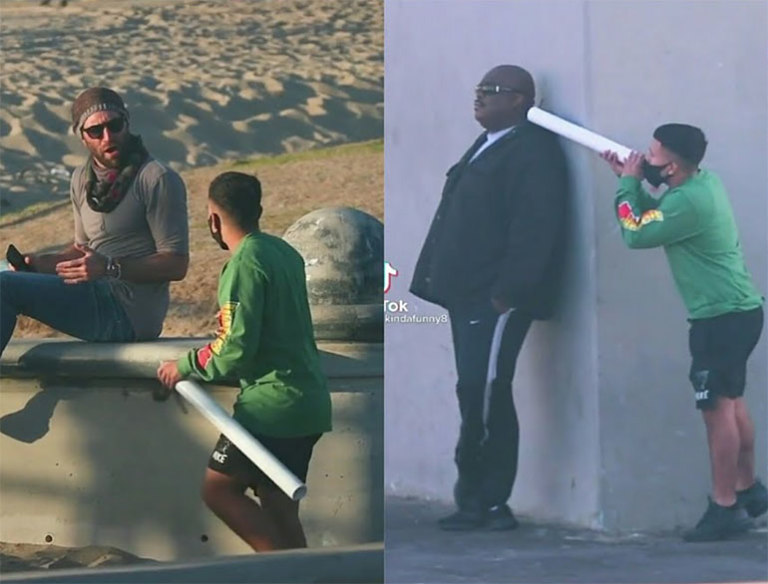
The image is built from two vertical halves. On the left is an open area with sand. On a low wall sits a bearded man in dark glasses, a headband and a gray top, holding a phone. A young man in a green hoodie with a colored patch, black shorts and a face mask turns toward him; in his hand is a long white tube, like a piece of plastic tubing.
On the right is a gray wall. A man in a dark jacket and glasses stands against it with his head tilted back, while the same young man in green says something into the tube, its end pointed at his companion. In the lower corner a semi-transparent TikTok banner is visible, so the image is a screenshot from a video rather than a standalone photo. Who the passersby are is unknown, and that does not need to be figured out for the joke.
From mumbling at a car window to millions of views
According to meme references, the phrase is tied to a TikToker with the handle jaykindafunny8. The earliest known use dates to July 2020: he mumbled a similar-sounding nonsense word (“muyaiyo”) while driving away from a drive-thru food window. The first prank video in which the phrase is repeated to throw a conversation partner off balance is dated September 4, 2020.
The real explosion came in December 2020: two videos gathered tens of millions of views each, by one estimate 85 and 137 million over several months. By May 2021 the hashtag had several billion views, and the creator called himself the head of “Chupapi Munyanyu.” These figures come from a single source, so they should not be treated as exact.
What “chupapi munyanyu” means
The phrase has no translation. Fragments of Spanish seem to be in it, such as “chupa” and “papi,” but the whole remains a set of sounds, and the point is that it means nothing. There are several versions of where the phrase came from, and no source gives a reliable explanation.
The prank mechanics are simple. The person pretends not to understand the language and repeats the phrase in a confident tone, while the passerby tries to work out whether they have been insulted and gradually gets lost. The tube in the frame is a prop from that particular video, an extra source of absurdity: it is unclear why one would speak into it.
Captions that rely on absurdity
Example one: “When they ask you to repeat yourself on a call and you're not ready for the question.” The filler phrase stands in for an answer: the person responds with sound instead of meaning.
Example two: “Told the shop I have everything, even though I came for cheese.” The caption takes the absurd confidence and moves it into an everyday situation, where the other person is completely unprepared for such a line.
Example three: “Parents when I explain how a neural network works.” The roles are split so that the left half is the listener and the right half is the speaker, and the gap in understanding is visible at once.
Example four: “A colleague reads me the contract terms, and I nod and answer him with a cryptic phrase.” Here two people seem to speak different languages, and one line is enough for the reader to imagine the whole conversation.
How to use the frame
The image works best for stories about misunderstanding: one person talks, the other cannot decode it. The left half can be captioned as the listener's point of view and the right half as the speaker's line.
The people in the frame are random passersby in someone else's video, so captions should be built on the situation itself rather than on their words or motives. It is better to present the nonsense phrase as harmless gibberish, not as the words of a real language.
A two-step approach also works well: first the caption announces that the person is trying to explain something serious, then it shows his line as “chupapi munyanyu.” The more serious the stated topic (taxes, studies, repairs), the stronger the effect of an empty answer. The difference in poses also helps: one man is relaxed and seated, the other stands by a wall. That pair is easy to relabel as “boss and subordinate” or “customer and consultant.”