What the image shows
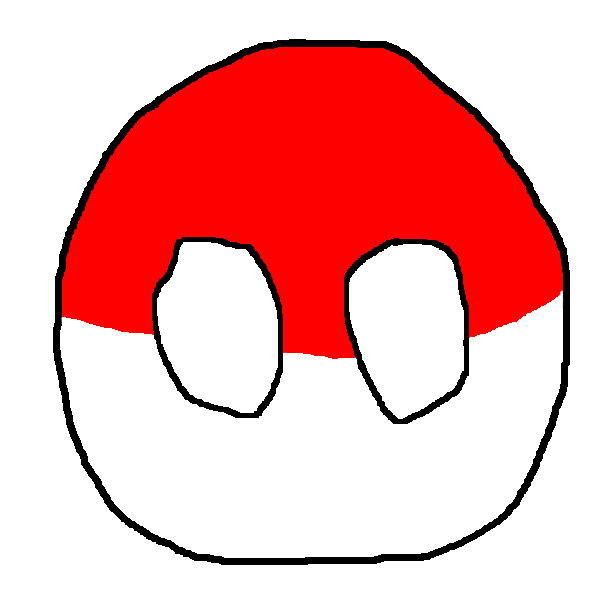
The picture shows a ball whose upper half is colored red and lower half white — the colors of the Polish flag. The ball has two large oval eyes, no mouth, and its outline is drawn with a thick black line. This simple shape serves as the basis for the entire series: the flag becomes the character's skin, and the character itself has no face or speech in the narrow sense, so all the humor is carried in the captions and plot.
The ball is made on the principle of minimalism: a circle, a color, and two eyes. Thanks to this, any country gets a recognizable character, and the authors can quickly draw new comics without elaborate detail work. The characters usually talk through captions and dialogue lines, and these lines highlight national traits, historical grievances, neighborly relations, or the current political situation.
History of origin
Countryballs took shape on anonymous imageboards, primarily on the English-language /int/ board of 4chan. According to a widespread account, the start of Polandball dates to 2008, when the first comics featuring the Polish ball appeared on that board. The exact author of the first works is unknown: the boards were anonymous, and the original files were often re-uploaded and reworked. The series spread actively around 2009.
Over time, balls for other countries appeared as well, and the term countryballs became the general name for the whole series. The comics moved on to forums, wiki communities, and social networks, where they were translated and expanded. Their own characters, relationships between them, and storylines emerged, and for many countries a stable ball image took shape, one that became fixed in fan culture and recognizable even to those who had never read the original comics.
How the comics are built
Typical comics are built on dialogues between the balls, in which countries mock one another: neighbors argue about borders, history divides them, and economics, language, or culture become the occasion for jokes. The humor is often based on a witty take on a historical event or cliché that's known to anyone familiar with the country, and on how the characters react to these events.
A separate genre consists of pictures where a country or its ball acts in situations tied to world politics, sports, language, and cuisine. The captions are short, sometimes a line of dialogue, sometimes an explanation of the panel. Understanding the joke often requires minimal context about the events being referenced, so the series is usually better appreciated by those who follow the news or are familiar with the region's history.
Why the series works
The series rests on the fact that simple shapes are easy to read. The flag instantly shows who is in front of us and immediately sets up the expectation of a joke. Because the characters are faceless, the viewer supplies their own familiar notions of the country, and the author plays on the mismatch between those notions and the plot. This mechanism resembles caricature: the simpler the drawing, the clearer the idea becomes.
The format is also convenient for spreading: short pictures are easy to forward, rework, and add to. The comics became part of internet culture, and many of the joke situations turned into recognizable memes used without any knowledge of the original works. This is a typical fate for a successful internet format: first the fans know it, then it moves into a wider environment and picks up its own jokes.
Controversial aspects
Countryballs is often criticized for building jokes on national stereotypes and historical grievances, and in some works the humor crosses over into crude mockery. However, the bulk of the comics are perceived as poking fun at politics, borders, and historical conflicts rather than at people of a particular nationality. Attitudes toward the series are mixed, and it's received differently in different countries: some see it as harmless satire, others as a reason to discuss the limits of acceptable humor.