A night road as a musical emblem
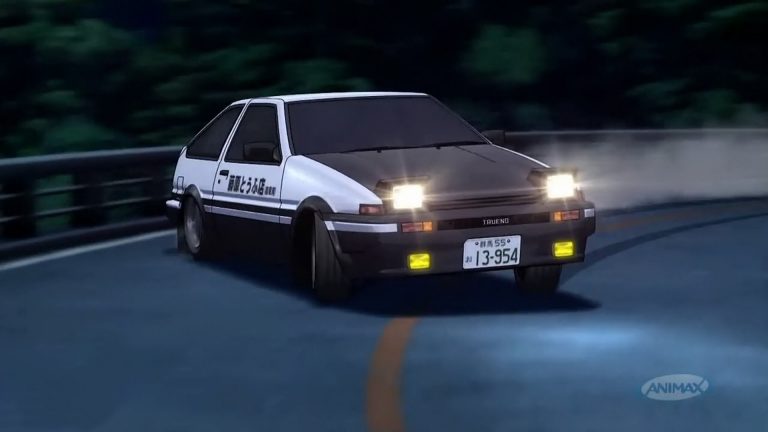
The illustration shows a white car with a black hood entering a turn on a dark mountain road. Raised headlights shine toward the viewer, yellow lights are visible lower down, and smoke trails behind the car. The front reads TRUENO, there is Japanese writing on the door, and the ANIMAX logo is in the corner. This is the familiar automotive image of Initial D. The specific episode cannot be determined from a single such image, and the still frame itself contains no music.
The car connects the song to the world of Shuichi Shigeno's work. In Initial D, young Fujiwara delivers tofu along mountain roads and gradually discovers that his everyday job gave him unusual driving skills. His Trueno Eight Six becomes part of the story of street racing. Thanks to this, the turn, the headlight glare, and the smoke in the illustration work as a brief emblem of a whole set of associations: speed, mountain switchbacks, and unexpected mastery behind the wheel.
The song before the remixes
Deja Vu is performed by the Italian musician and producer Dave Rodgers, whose real name is Giancarlo Pasquini. The track appeared in the late 1990s and entered the musical world of Initial D Second Stage in 2000. It belongs to eurobeat, which noticeably shaped the sound of the car scenes in this anime. The musical history began long before the short online clips: the internet later turned an already existing song into an independent comic signal.
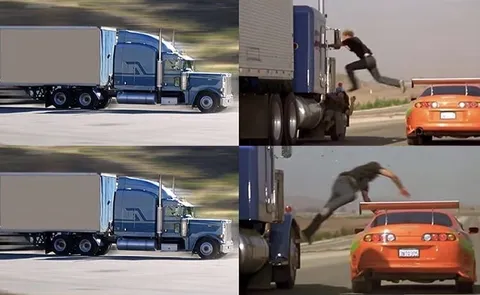
In the mid-2010s, eurobeat was increasingly layered over footage of car movement and other suitable scenes. At first the link to racing was direct; then edits transferred it to running people, sliding objects, and animals. In April 2016, Naaquh published the compilation Eurobeat/Initial D WEBM Compilation, which also used Deja Vu. Such compilations helped viewers recognize the musical device regardless of familiarity with the anime itself.
How the sound assigns the driver
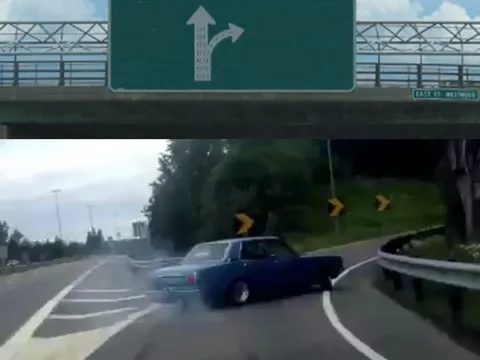
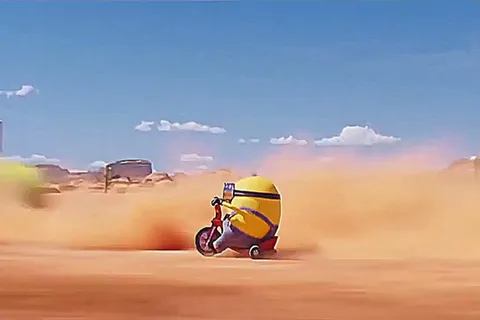
The main action of such a meme happens through a change of scale. In an ordinary video, an object may simply roll across a smooth floor, but a fast rhythm and energetic vocals invite viewers to perceive it as an intense race. A successful turn starts to look like a complex maneuver, and a random slide becomes a demonstration of technique. The viewer does not have to believe this interpretation: the humor relies precisely on the obvious gap between the seriousness of the musical accompaniment and the modesty of what is happening.
The edit often emphasizes the moment when the trajectory becomes unusual: the object spins around, suddenly accelerates, or passes dangerously close to an obstacle. The music gives this movement the expected resolution and makes the viewer a participant in a conditional race. In such clips, Deja Vu appears alongside Running in the 90s and Gas Gas Gas, but these titles refer to different songs. The shared image of speed unites them in memes without turning all of eurobeat into one composition.
A kitchen race and a sprint to the window
In the first invented edit, a person places a lemon on the table, and it rolls around a standing cup and stops neatly at the edge. At the moment of the turn, Deja Vu kicks in, the camera zooms in on the trajectory, and the caption “Final lap” floats over the frame. There are no real competitions: the fruit is credited with confident control only thanks to the music, the chosen moment, and this caption. The cup, meanwhile, becomes a conditional obstacle that the racer seemingly avoided on purpose.
In a second invented clip, an office worker on a rolling chair pushes off the desk to close a window before rain. The eurobeat accompanies a single spin between boxes of paper, and before the window latch clicks, the caption “New track record” appears on screen. A third possible storyline: a robot vacuum goes around a chair leg, and a title announces “Last lap.” In all three cases, the joke is created by the combination of sound, caption, and trajectory; a single photo of the object would convey only part of such an invented race.