What's shown in the picture
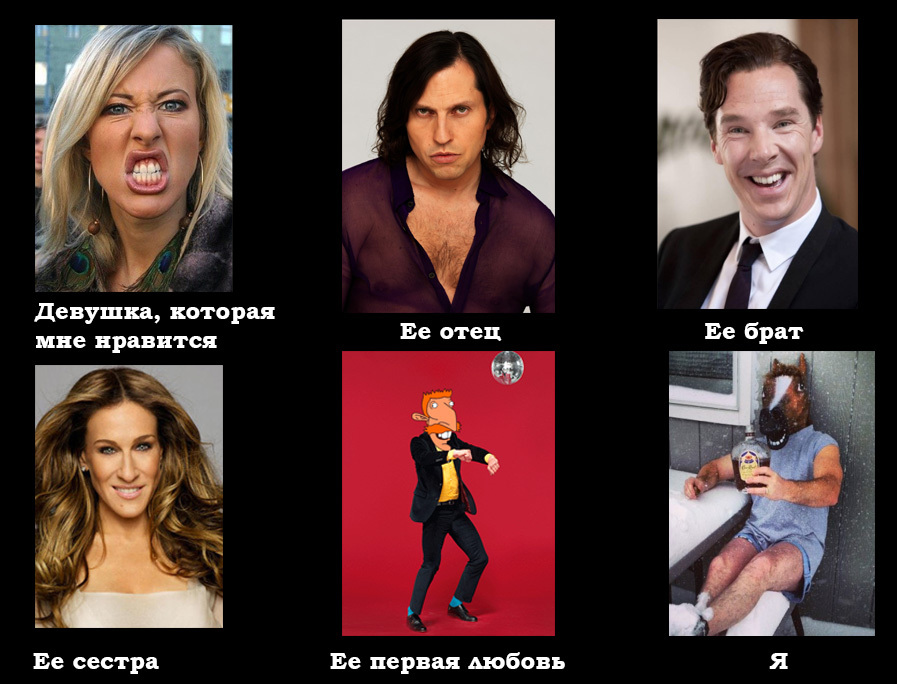
The meme consists of six images arranged in a grid on a black background. In the top row are "the girl I like," a woman with an angry face contorted with rage, then her father, a man with long dark hair and an open shirt, and her brother, a smiling man in a business suit. In the bottom row are her sister, a woman with long blonde hair, her first love, an animated character in a dance pose against a red background, and "me," a man in a horse-head mask sitting with a bottle in his hands.
The captions are written in bold white font, so every line reads instantly. Visually the picture rests on contrast: the faces in the top part look fierce or self-assured, while the final image is deliberately ridiculous. It's exactly this drop-off that creates the effect on which the whole meme is built.
History and spread
The exact date the Russian-language version appeared hasn't been established; it's roughly dated to 2011. The English-language predecessor, which lists "your crush," "her father," "her brother," and "you," has been known since November 2014, when it was posted on Instagram. At that point it featured five celebrity images, with the final frame showing a ridiculous man captioned "you."
The template then spread through fan communities: in early 2015 a version based on video games appeared, in 2015 one with characters from "The Avengers," and in 2016 one with celebrities on Pinterest. In February 2017 the format reached Facebook via 9GAG, and in 2019 a generator appeared on Imgflip. Most versions spread through social networks, forums, and themed boards, with each author substituting their own characters.
How the meme is used
A typical meme follows a simple pattern: several striking, imposing figures are listed as obstacles, and the final element, "me," announces that the speaker stands at the very end of the list. Self-deprecation is the key here: the author emphasizes his own hopelessness, and thanks to that the joke lands gently, without offense toward any real person.
The format is easy to adapt: the characters can be swapped for characters from a favorite show, members of a band, or family members, while the final caption stays the same. That's why the meme keeps coming back in messaging, where it's used to explain personal setbacks or to laugh at a situation in which a person clearly isn't competing with their rivals.
Why the joke is recognizable
The meme's strength lies in its simplicity. The viewer grasps the structure in a second: rivals on top, "me" at the bottom. The ridiculous final frame, the horse-head mask, and the bottle in hand heighten the sense of absurdity and keep the joke from becoming too serious.
The meme also works as a mirror: people often use it to describe their own feelings toward someone they have a crush on. That's why it's used both as an ironic comment on romantic failures and as a way to talk about one's own insecurity. Unlike many templates, it requires no explanation, and its meaning registers instantly.