A grid of two moral axes
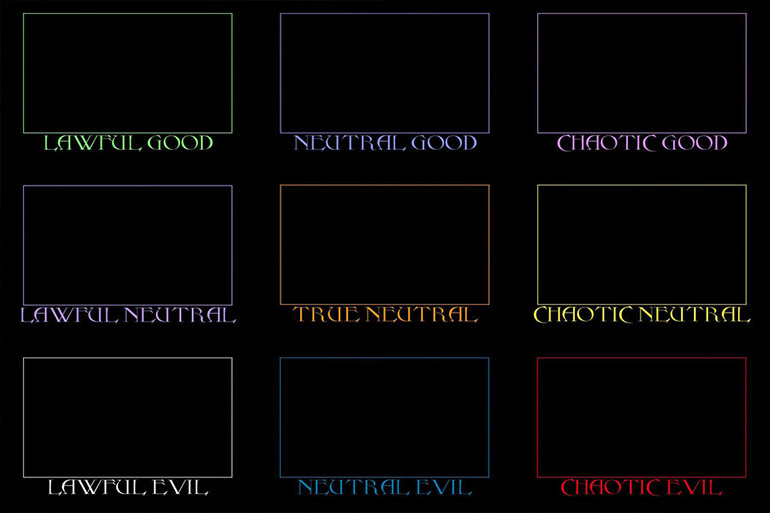
The local picture contains a table with nine empty or barely distinguishable cells. It serves as a basis for sorting by two traits: attitude toward order and attitude toward moral good. In the classic system the nine combinations include lawful good, neutral good, chaotic good, and the corresponding neutral or evil variants.
Such a map is useful because it turns a long characterization into a coordinate. A character can help others but ignore rules, or keep order while pursuing a selfish goal. Middle positions avoid a simple split into heroes and villains. In practice people use the grid much more freely, adding their own categories or turning the axes into “tidy vs. chaotic” and “likes tea vs. likes coffee.”
Connection to tabletop role-playing games
The nine-part classification is known primarily from the role-playing game Dungeons & Dragons. It combines two dimensions: lawful or chaotic, and good or evil, with neutrality as the middle or as a separate attitude. Players used it to briefly describe a character’s moral outlook, but the game rules do not claim that any personality can be fully placed in one square.
Over time the table moved beyond game sheets and became a universal internet form. People sorted characters from works of fiction, celebrities, dishes, school habits and memes into it. The date when this image appeared is unknown; it simply uses an already familiar structure. It should not be called the original template of the whole system: the grid existed as a game tool long before online collections of characters.
Why classification is funny
The grid promises a simple and objective solution, whereas morality and behavior usually depend on circumstances. The comic effect comes when minor or absurd differences are placed under serious headings. For example, three ways of stealing the last cookie can be divided into lawful, neutral and chaotic, as if it were a complex ethical theory.
Another source of humor is the argument about placement. Fans may disagree about which cell a character belongs in, and offer long arguments over one playful picture. Such a discussion turns into a game in itself: the classifier provokes debate even when the result has no practical consequences. The empty table in the local file invites the audience to fill it with their own examples.
Examples to fill in
For a family version, participants can be placed by their attitude to the rules of a board game: one counts points honestly, another pretends not to notice a disputed move, and a third changes the rules in the middle of a game. To add the good–evil axis, one can show who helps a newcomer, who plays only for themselves, and who follows the instructions too literally.
For a work chat, categories such as “lawful order,” “neutral improvisation” and “chaos with good intentions” would fit. For example, a person who creates a separate spreadsheet for every task ends up in one cell, while a colleague who sends an important link without explanation ends up in another. Examples should be recognizable and should not present the table as a scientific assessment of colleagues’ character.
Use it as a game, not a diagnosis
A single picture rarely covers all of a character’s decisions. In different circumstances a hero can act differently, and an author’s interpretation does not become canon just because it has been placed in a cell. That is why the diagram works better as a conversation starter or a fan joke than as an accurate psychological model.
If real people are placed in the table, it is important not to disguise insulting labels as harmless classification. Calling an acquaintance “evil” because of one disagreement is not analysis but an attack. For a public version it is better to use fictional characters, types of habits or neutral play preferences. Then the familiar grid supports creativity and discussion without presenting a subjective judgment as an established fact.