What is happening in the frame
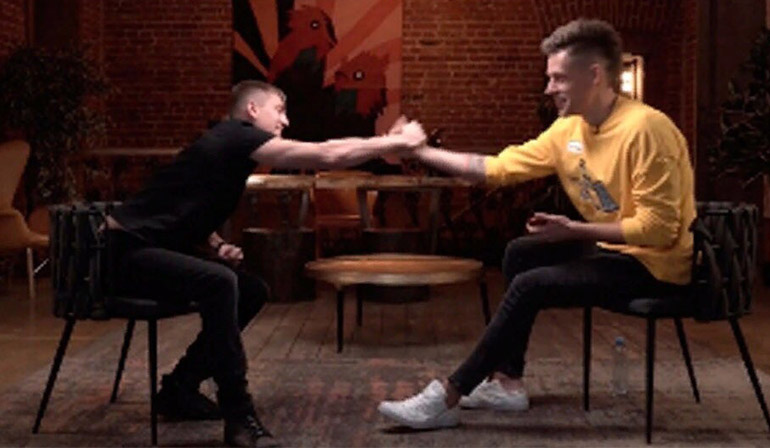
The scene is shot in a room with brick walls and warm, muted light. Two men sit on black chairs on either side of a low round table. On the left is a man in black clothing; on the right is Yuri Dud in a yellow sweatshirt and white sneakers. Both have stretched their arms toward each other and clasped hands over the table, and Dud is smiling and looking at his counterpart.
On the wall behind the table is a bright panel with birds. This is an ordinary studio interview setting, and the simplicity of the frame is what makes it a convenient base: nothing extra, all attention on the gesture.
The episode the frame comes from
The guest of the episode was comedian Alexei Shcherbakov, a participant of the show Chto Bylo Dalshe? ('What Happened Next?'). The interview was published on the vDud channel on January 28, 2020 and gathered millions of views.
According to retellings, what prompted the handshake was the two guests agreeing that they love their wives. For the template itself this does not matter: the meme became the gesture, not the topic, and captions almost never refer back to the original conversation.
Jokes about the episode appeared right away, but a stable format, according to descriptions, took shape later, by the end of 2020.
Where the joke hides
The meme is built on a contrast of roles. In public perception, Dud is an interviewer with a measured manner, while Shcherbakov is a comedian with a bolder stage style. The firm, almost sporty handshake over the table shows that two different worlds have found a common point.
In memes this turns into the formula 'A and B, united by something third.' Captions are placed on the figures, and sometimes on the gesture itself, and the surprise of the alliance is what makes it funny: people or things that usually argue suddenly agree completely.
Captions for the template
A few invented examples, each for its own setup.
Left: 'The one who loves getting up early'; right: 'The one who loves sleeping until noon'; above the hands: 'Both hate alarm clocks on Mondays.' The opposites are linked by a small but familiar annoyance.
Left: 'Cat'; right: 'Owner'; above the hands: 'Agree that the bowl should be full.' There is nothing surprising about agreement here, but the presentation makes it solemn.
Left: 'Programmer'; right: 'Tester'; above the hands: 'Let this bug stay until Friday.' The joke works on the unexpected collusion of sides who usually argue.
Left: 'Student'; right: 'Teacher'; above the hands: 'Quiz canceled.' The handshake looks like a rare case of complete mutual understanding.
Tips for use
The template works best when the captions on the left and right people set a clear pair of opposites, and the third line above the hands names a shared occasion. Without such a pair the gesture loses its meaning: this is a picture about an alliance, not a greeting.
Don't attribute statements and beliefs from the captions to the real people: this is a joke about a gesture, not about the position of Dud or Shcherbakov. The frame reads well even at small size, since the gesture takes up the center of the picture.