What is shown
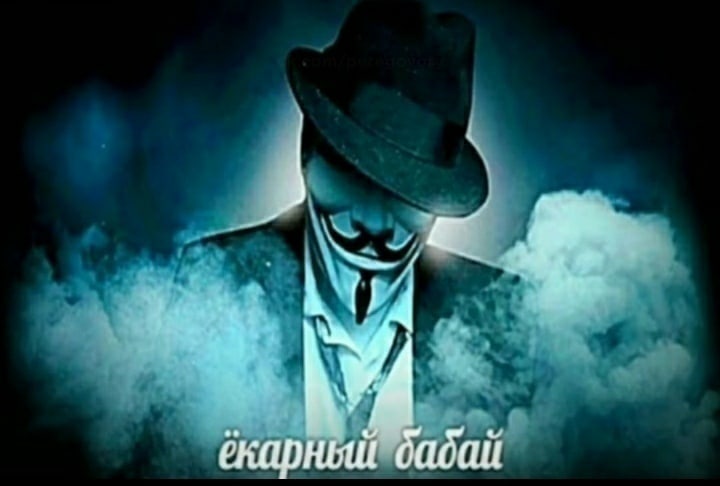
The picture is done in turquoise and blue tones. A figure in a black hat stands with its head lowered, the face covered by a white mask with a thin mustache and a pointed beard; the clothing is dark, bluish smoke curls around, and the edges of the frame are darkened. At the bottom, in light lowercase letters, it reads “yokarny babai.”
This mask is known as a symbol of Anonymous and is popular in internet aesthetics: a mysterious character from whom a loud statement is usually expected. Here, instead of a dramatic threat, there is a funny old-fashioned exclamation.
What the expression means
“Yokarny babai” is a soft exclamation used in place of rude words: it expresses surprise, vexation or irritation, and sometimes joy. The word “babai” is familiar in Russian as a children’s bogeyman, as in “the babai will come.” That is why the combination sounds both homely and a little fairy-tale-like.
The origin of the expression is not established. Several versions are proposed: for example, “babai” is traced to a Turkic word meaning “old man, grandfather,” and “yokarny” is seen as a softened replacement for a swear word. No version is proven, so this is more folk etymology than an established fact.
How the joke works
The picture builds an expectation: the hat, mask and smoke hint at a serious, possibly threatening message. Instead, the viewer gets words from the repertoire of a grandfather at his dacha. A similar contrast recurs across a whole family of templates, where a stern image is combined with a homely tone.
Other mild exclamations are built on the same scheme, such as “yely-paly,” “yedryon baton” and “yoshkin kot.” For the reader they form one set, and the different variants reinforce one another.
Why it is funny
Several things are funny at once. First, the genre mismatch: the mask, smoke and hat promise seriousness. Second, nostalgia: such words are more often heard from older people than from peers. Third, self-irony: someone who wants to swear carefully sidesteps forbidden words, and the result is a polite rebel.
The meme does not require knowledge of any particular event. The picture and a familiar phrase are enough, which is why it travels easily through chats and comment threads.
Caption examples
“When the printer broke five minutes before the report was due.” A tense moment and a mild exclamation create a contrast: instead of an outburst, “yokarny babai.”
“The neighbor is drilling again on a Sunday.” The expression sounds like a weak protest from someone who wants to object but was raised too well.
“Me, seeing the receipt at the store.” The serious mask against the price of cheese: the intonation is grand, the words are modest.
“When I realized I’d left the kettle on.” The joke is that real fear comes out in the most homely words.
Why this kind of joke lives on
The approach is easy to repeat, because Russian has many softened exclamations. You can take any old saying and put it under the same silhouette: the more old-fashioned the word, the stronger the contrast with the image of a mysterious hero in a mask.
Note the behavioral layer of the joke too. Such a caption portrays a person who wants to express strong feelings but observes good manners in any circumstances. It is a recognizable type: polite, restrained, but visibly annoyed. That is why the meme fits so well into real work and household trifles, where swearing loudly is awkward and staying silent is impossible.
Tips for use
Captions work better when the situation is genuinely unpleasant and the reaction stays polite. Change the expressions but keep to one register: old-fashioned, harmless sayings give the needed contrast. Do not replace them with real swearing, because that would destroy the main contrast.
Do not attribute a specific author to the picture or tell its origin story: it is not established, and the Anonymous aesthetic has long spread across the internet without any single source.