A player assembled from characters
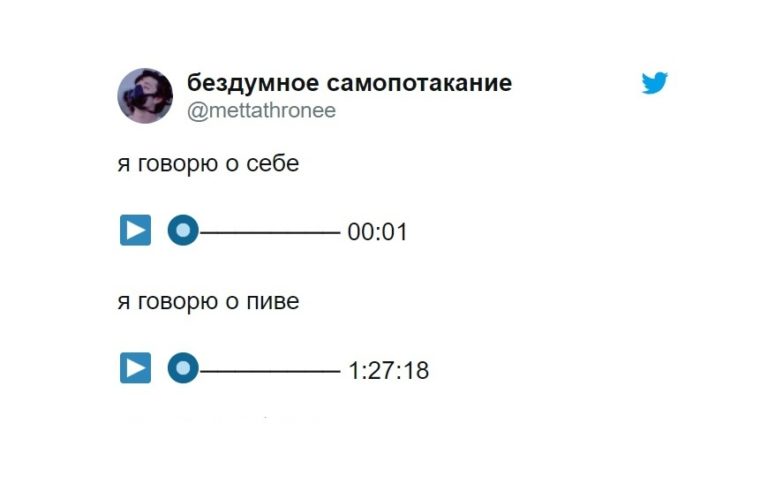
The screenshot shows two repeating rows: a play button, a round marker, a horizontal bar, and a time. Between them are the captions “I'm talking about myself” and “I'm talking about beer.” No recording is attached: this is a text imitation of a player, and the minutes and seconds shown work as part of the joke. The screenshot is credited to the account @mettathronee; it is the comparison of two imaginary recordings that turns the layout into a standalone punchline.
The resemblance to an interface matters because the reader is used to seeing an audio length next to the bar. Here the numbers become the punchline. The first story supposedly fits into a second, the second stretches to over an hour: the author winks at how easily a conversation about a favorite subject turns into a lecture without end. The imaginary technical label literally measures enthusiasm. A symbol-based copy-paste with a play button and progress bar was already seen on Twitter in 2015; later it was also used to compare two imaginary recordings. In this screenshot the earlier construction gets a Russian theme about one's own stories and beer.
Two durations instead of two files
The top and bottom lines form a single comparison. The first promises brevity; the second, the habit of explaining at length a topic that the speaker finds especially interesting. So the long time should not be read as the real length of an audio recording: it is exaggerated to a comic scale and signals a potential monologue.
This device plays both with trust in the interface and with expectations about voice messages. In ordinary correspondence, a long track means the listener will have to set aside time; here the author announces what the conversation will be about before anyone listens. The result is an instant characterization of the interlocutor without any recording of their voice — in this case self-ironic: the account jokes about its own interest in beer.
Invented audio pairs
The examples are invented. “I'll quickly explain why I love board games” — 00:03; “I'll talk about the rules, the expansions, and our game last night” — 02:46:00. The point is not the exact length but how a short promise gives way to a huge topic. Another variant: “How was my vacation?” — 00:05; “A route through all the museums and where it's best to buy tickets” — 06:12:30: one question launches a detailed excursion.
A pair can also be built on a change of mood: “Now I'll just name my favorite song” takes a moment, while “why this album was the soundtrack of my school years” turns into a long story. It matters that the line captions promise comparable actions — a story and its ballooning, not two random events. Then the reader understands why two tracks are shown visually.
From an interface copy to a characterization of the speaker
The symbol copy of the player appeared on Twitter in 2015, while dated comparisons of two imaginary recordings are known from 2017. In the Russian-language wave of 2018 the layout became a convenient frame for one's own topics: it was enough to swap the names of the conversations and keep the time contrast. These traces relate to the development of the construction; they do not establish the author of this particular screenshot.
The pair “about myself / about beer” compares not the short and long versions of one story but two interests of the speaker. Supposedly a second is enough for one's own biography, while the hobby gets an hour and a further twenty-seven minutes. This is not simply a listener's complaint about a long message: the author casts themselves as a person whose favorite topic takes up more room than a story about their personality. Duration becomes a playful self-portrait.