What the frame shows
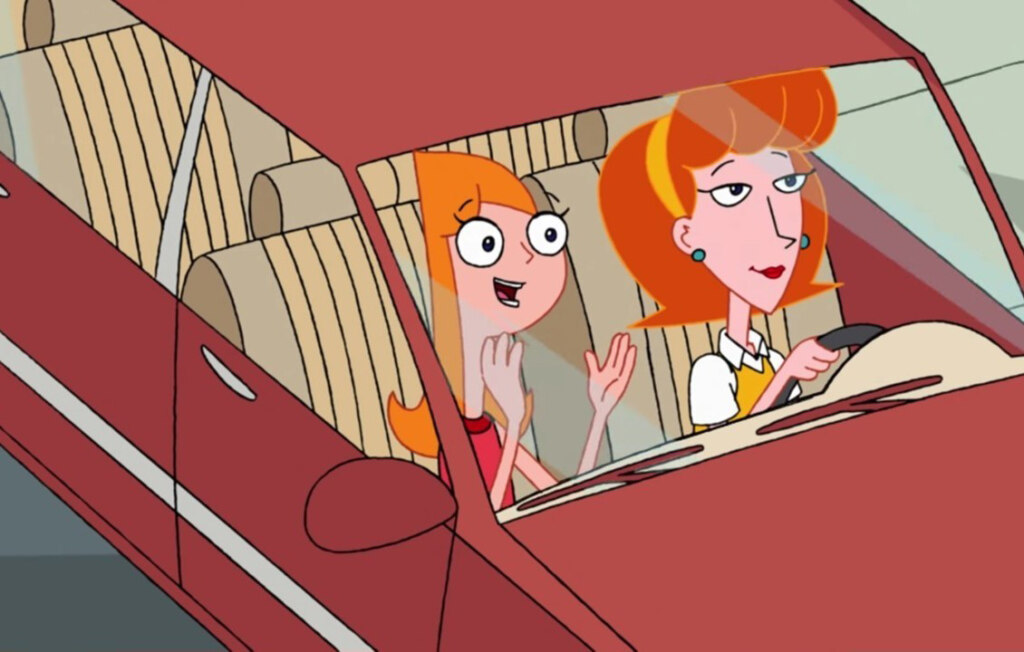
The scene takes place inside a red car with beige striped seats. On the left, in the passenger seat, sits Candace, a red-haired teenage girl: her eyes are wide open, her mouth is open, and both palms are raised in the gesture of an excited explanation. On the right, behind the wheel, is her mother Linda, in a white blouse with a yellow vest, with red lipstick and turquoise earrings. Linda looks slightly to the side with a raised eyebrow and half-lowered eyelids.
There are no two panels in this frame: in the cartoon it is a single scene, and the two-part format is created by users, who add a caption above Candace and, below or beside it, Linda's line.
The series and the history of the meme
Phineas and Ferb has aired on Disney Channel since 2007. Linda, the family's mother, and her daughter Candace appear throughout the series. Candace is the older sister of the inventors Phineas and Ferb, who build enormous schemes over their summer break, while she tries to show their antics to their mother.
According to the meme catalog, the line was spoken in the episode “Rollercoaster,” which aired in August 2007. It spread widely as a caption format in November 2019, after a Reddit post in which a user shared a version with a gloomy observation about icicles. After that, many imitations with absurd musings appeared.
How the joke works
The format requires two parts. In the first, Candace says something strange, awkward, or excessively grim, the kind of thought that usually comes to mind right before sleep. In the second, Linda answers with the familiar phrase. What makes it funny is that the mother says it very calmly, with parental weariness, even though the line sounds like a diagnosis.
Linda's expression matters no less than the words: she is not angry or panicking, but seems used to her daughter's oddities. Because of this, the joke comes across as warm rather than cruel.
Caption examples
Candace: “What if everything I think of as a color looks different to other people.” Linda: “Sometimes I worry about you, Candace.” A classic philosophical oddity in a nighttime rhythm.
Candace: “If I lie down on the floor, I'll be closer to what I dropped.” An example of everyday absurd logic that sounds proud of itself.
Candace: “I think a teapot would make a better boss than our manager.” Linda replies with the same line, and the joke takes on an unexpected social undertone.
Candace: “I feel like my shadow has a life of its own.” Here the humor comes from the juxtaposition of childlike fantasy and parental anxiety.
Tips for using it
A good caption for Candace should be short and strange, but neither mean nor dangerous. The less expected the thought, the stronger the effect of Linda's reply. It is better not to change the phrase itself, since it is exactly what works as the recognizable response. If you want a version without two parts, you can leave only the caption for Candace and let the viewer hear the reply for themselves.
An additional technique: you can swap the roles and let Linda speak after someone else's line, for example in a chat where one person has come up with a strange idea and another answers with a picture. Then the meme already works as a reaction, without a second panel.