The contrast behind the joke
History TV channels such as the History Channel and its counterparts in various countries were originally created as platforms for documentaries about wars, civilizations and significant events of the past. However, in the pursuit of ratings, a significant part of the broadcast schedule, especially in the evening and night hours, came to be given over to shows about paranormal phenomena, ancient astronauts, conspiracy theories and other topics far removed from strict historical scholarship.
The most famous symbol of this shift became the American show Ancient Aliens, whose host, Giorgio Tsoukalos, with his distinctive hairstyle and emotional speaking manner, regularly put forward hypotheses about aliens interfering in human history. The contrast between the serious daytime content and such evening programs became the basis of the meme.
The illustration
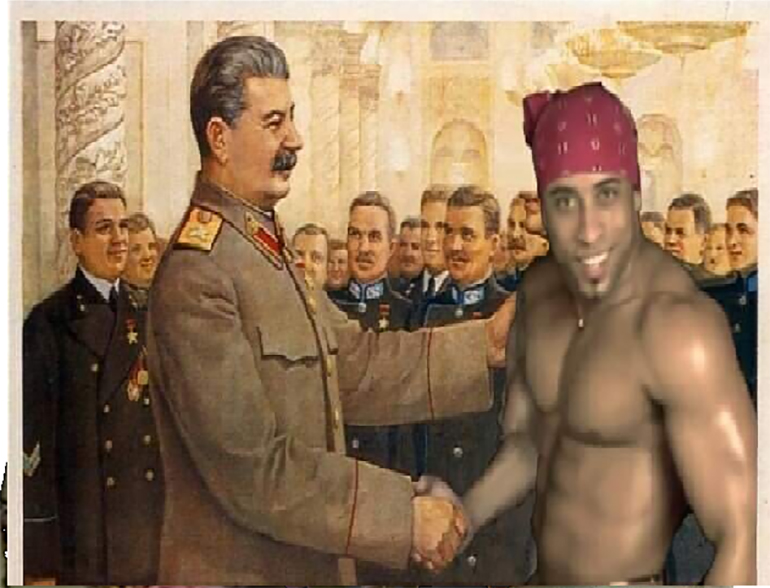
The specific image most often used to illustrate this joke is a photo parody based on an old Soviet propaganda poster or photograph: Joseph Stalin in military uniform solemnly shaking hands with an interlocutor against a backdrop of generals. In place of the historically accurate figure, a ridiculous character has been pasted into the frame: a bare-chested man in a bandana with an exaggeratedly joyful expression, visually completely out of place in the official setting of the original photo.
This juxtaposition of serious historical visuals with an absurd insert clearly conveys the idea: what viewers expect to see on a history channel (strict documentary about the past) is replaced at night by something entirely different in tone and credibility.
How the joke spread
The “serious by day, absurd by night” format became a popular template for jokes about television in general. History channels, however, were the most frequent target of such quips because of the striking gap between the channel's stated mission and the actual content of part of its airtime. Such jokes circulated on forums, in TV-related communities and among documentary enthusiasts who mocked the decline in content quality.
Over time the template expanded and began to be applied not only to history channels but by analogy to any media or platform that declares one mission while in practice drifting toward entertainment or sensationalist content.
Typical captions
The meme is often captioned with lines like “History Channel by day” / “History Channel at 3 a.m.,” where the first part is illustrated by a stern archival image and the second by something absurd like the photo parody described above. Another common caption is “When the channel runs out of documentaries but still has to fill airtime.”
A reverse approach is also used: the image with the absurd insert is captioned simply with the title of an aliens or mysticism show, without further explanation. The assumption is that the audience will get the hint about the declining quality of history channels' evening programming on their own.
Why the topic remains relevant
Shows like Ancient Aliens have aired for many years and have spawned numerous spin-offs, so the joke about the strange evening content on history channels periodically returns to the info space whenever such shows announce a new season or come up in discussions about declining trust in documentary television.
Thanks to the recognizability of the “pseudoscientific night show” format, the meme remains understandable to a broad audience even without knowing specific programs. The underlying idea (the mismatch between a channel's declared seriousness and its real content) is familiar to television viewers in many countries.