What is depicted
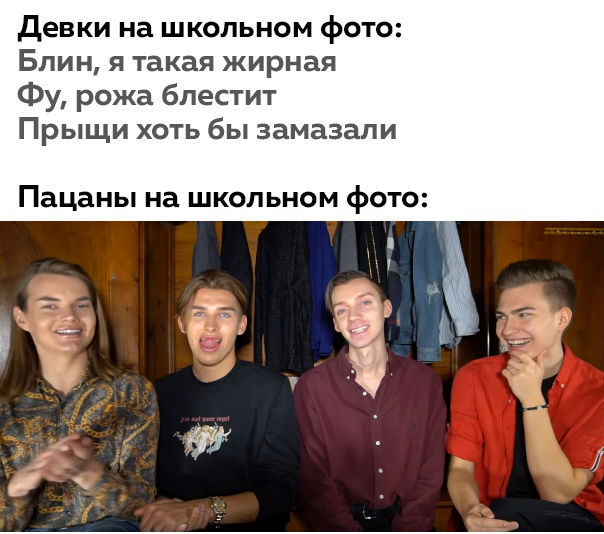
The top part of the picture is text in bold. The heading “Girls in school photos:” is followed by three short first-person lines: the heroine considers herself overweight, complains that her face is shiny, and wishes she could cover up her pimples. Then comes a second heading, “Guys in school photos:”, and a photo.
The bottom part is a horizontal shot of four young people sitting side by side in front of a wall with wooden panels, with clothes hanging on it. All of them look at the camera and smile: one spreads his arms and folds his palms, another sticks out his tongue, a third stands straight and smiles, and the fourth rests his chin on his hand. The clothes are multicolored: a patterned shirt, a black sweater with a print, and burgundy and red shirts.
There are no names or captions in the photo. It looks like a frame from a video, but nothing definite can be said about its source, and in the joke itself the people in the photo play the role of nameless “guys”.
Origin
The original source of the caption and the photo has not been established; the date of first publication and the author of the caption are unknown. For that reason, the picture is better considered an anonymous template rather than a story about specific people.
The two-block format, with text on top and a photo below, is typical of internet images built on opposition. Such a composition is quickly read in a feed and needs no explanation, so it is easily copied and remade.
How the contrast works
The joke rests on two expectations. First: girls in school photos worry about their looks. Second: guys take pictures calmly and attach no importance to the shot. The top text names the first reaction, the bottom frame shows the second, and the difference between them creates the funny effect.
The pause between the blocks matters. The heading “Guys in school photos” sets a full stop and makes the reader switch gears. While they wait for self-criticism, the photo shows four relaxed young men, and the expectation flips in an instant, like a twist in a joke.
The joke is best read as a play on familiar roles, not as an assessment of real people. Generalizations about “girls” and “guys” are conventional: many people take photos in the way described in the opposite block, and vice versa.
Caption examples for your own version
Below are three invented variants on the same structure. All of them keep the contrast between the two blocks.
Top: “Girls in a photo in a notebook: we retake it until we like it.” Bottom: “Guys in the same photo: took one shot and went to lunch.” The everyday detail works: a comparison of a long process with a single quick shot.
Top: “Girls at the prom: we check the hairdo in every mirror.” Bottom: “Guys at the prom: fixed the collar and ready.” The funny part is that the main gesture in both blocks is the same in meaning, but it lasts different amounts of time.
Top: “People in the group chat: whoever didn't post a photo is as if they weren't there.” Bottom: “Everyone else: well, we were there.” The example flips the logic of the chat at the end, so you laugh at the rule itself.
How to use the template
Keep the two parts: text on top and photo below. The bottom frame should look relaxed and have a different mood from the top block, otherwise the contrast disappears.
Do not turn the template into a joke about a specific person. A caption about “girls” or “guys” remains a generalization, while a specific person's name, city or appearance is already a personal topic, and it is better not to touch it.