What is depicted
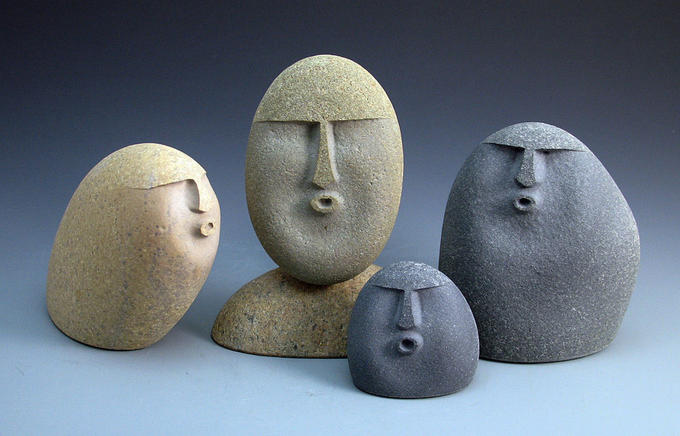
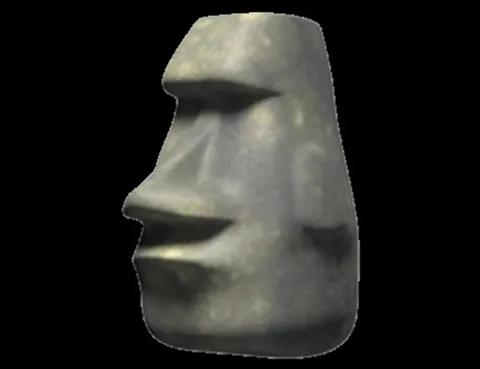
The photo shows four stone sculptures of different sizes against a light background that shifts from dark at the top to bluish at the bottom. Two of them are gray: one large, the other very small. The other two are beige-sand: one stands in the center on a stone base, the second, on the left, leans to the side and is shown almost in profile. Each has a horizontal line carved in its upper part, resembling a fringe or an eyebrow; below it runs a narrow vertical nose, and beneath that a tiny round mouth.
The sculptures have no eyes; their role is played by the brow line and the nose. The expression, however, reads easily: a sympathetic “oh” or “oof.”
Who made the stones and how they became a meme
According to available information, the stones were made by the Silver Stone Handcrafted studio near Chicago, using sandblast stone carving. The works appeared on the studio’s website in April 2018 in a series with various combinations of faces.
As a meme, the image reportedly took hold in December 2019: a user posted a photo of the stones in a comment on 9GAG, the comment received many upvotes, and people began looking for new shots. In January and February 2020 the pictures spread across Twitter, Tumblr and Reddit. Neither the author nor the studio’s owners made them as a joke: viewers made them into a meme.
Why “oof” is understood without words
“Oof” is an interjection that conveys both a light physical blow and social awkwardness. It is pronounced with pursed lips, and the round stone mouths show exactly that shape. The stone adds irony: the reaction is carved for the ages, yet it expresses a fleeting “ouch.”
Since there are several faces, the picture also suits collective reactions. Four stones are like spectators who together sighed over someone’s failure. This sympathy is more often playful than serious.
A short “oof” easily passes from speech into an image: it needs no explanation, it is enough to show a rounded mouth. That is why the stones read well where words fall short or one doesn’t feel like writing them.
Examples for your own caption
“My friend in the group chat: look what message I sent to the wrong person” and below, four stones — a class of sympathetic spectators.
“The teacher reads my grade out loud in front of the whole group” — stones as an audience frozen in place.
“A football commentator after a penalty that hits the crossbar” — a silent “oof” instead of words.
“Me, discovering that I sent a meme to the boss’s chat” — the stones serve as an inner voice.
How to use the template
It works best as a reply to someone else’s slip-up, when you want to say “I understand how awkward that is for you.” Don’t use it when a person has actually been hurt or is grieving: the joking tone would be out of place. Keep captions short so they don’t cover the faces. The photo is clear even at a small size, so it suits comments and stickers.
The reverse also works well: caption the stones with your own awkwardness rather than someone else’s. Then the viewer sympathizes with the author, and the author laughs at themselves in advance, so the joke comes across as kinder.