A personal confession that repeated too often
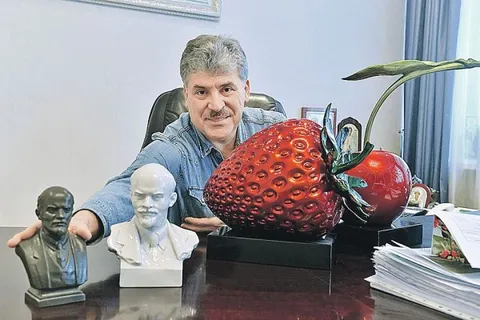
On December 23, 2017, the congress of the Communist Party of the Russian Federation nominated Pavel Grudinin as its candidate for president of Russia. The director of the Lenin sovkhoz presented a recognizable economic image: in public photographs and discussions, strawberries often appeared beside him. However, the verbal meme grew out of another part of the campaign: uniform messages on social networks.
In January 2018 a text circulated in the voice of a person who had not previously taken part in elections. The narrator supposedly intended to vote for Grudinin and ended the confession with the formula “Candidate of the people!” The repetition of the same words under different names turned a personal voice into a suspiciously smooth chorus. At the end of January Ruslan Shaveddinov published a screenshot of such a series of comments; users began discussing it as an example of artificial campaigning.
Speculation about bots and clients accompanied this story, but the meme's mechanism did not depend on a proven contract or an established performer. Its visible basis was the identical speech of many accounts. Parodists reproduced it deliberately, replaced Grudinin with other figures, and attributed support to people who could hardly have made such a confession.
Strawberries instead of text
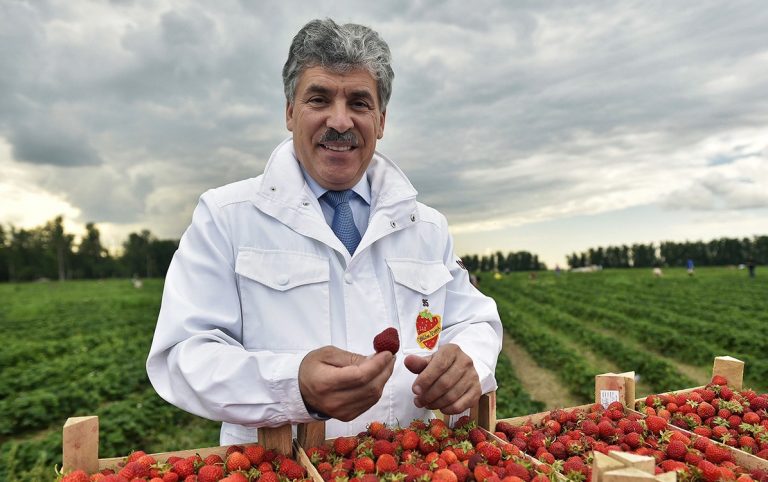
In the photo Grudinin stands beside wooden crates full of strawberries and holds a berry in his hand. He wears a white work jacket over a blue shirt and tie. Behind him are a green field, trees, and a cloudy sky. He smiles and faces the camera, so the picture looks like a demonstration of the farm and its harvest.
There are no comments, slogans, or screenshots of a page with identical messages here. The image gives the copypasta a face: the strawberries link the photograph to the public image of the sovkhoz head. The date of this shoot is not established, so it cannot be automatically equated with the day of nomination or the moment the repeated posts appeared.
How a sincere tone becomes parodic
The original construction combines three steps: former indifference, a sudden decision, and a short solemn conclusion. The narrator seems to have overcome apathy and found an exceptional candidate. When the confession repeats word for word, the promised individuality disappears. The result is a speech that declares a personal conviction while displaying a ready-made template.
The parodic substitution keeps this serious tone and changes the scale of the choice. In place of a political candidate there may be a neighbor's cat, a kettle, or a person who did a useful small thing. The abrupt shift from a presidential campaign to a domestic decision reveals the comedy of the construction. The more solemn the support, the more noticeable the disproportion of the reason.
Variants with a portrait of a famous person add a second role: the name under the picture depicts an imaginary supporter. The attributed line works as a false quote inside an obvious joke. The main action takes place in the text, so the format lives even without a photograph; it is enough to keep the rhythm of a sudden address and the final endorsement.
Who gets supported in invented elections
Residents of an invented building choose a name for the courtyard team. One writes: “I have never taken part in such disputes before, but now I will support the ‘Lazy Pigeons.’ A team of the people.” The reason is that pigeons take over the playground every morning before anyone else. The campaigning tone turns an ordinary bird into a candidate with a convincing organizational base.
In another variant, a tabletop game club is looking for a host. A participant solemnly declares support for a friend who was the only one to read the rules before the meeting. After several identical messages, the others realize that the vote has already become a parody of mass unanimity. A small useful habit gains the stature of political dignity.
The third example concerns the choice of a kettle for a shared kitchen. The author insists that he was not interested in appliances before, but now he will give his vote to the model that does not whistle in the mornings. The final formula about the popular choice amplifies the exaggeration: a personal wish to sleep is presented as a program for everyone. These scenes use the structure of copypasta while keeping its main conflict between an individual confession and a ready-made speech.