The thriller's ending, not an actor's incident
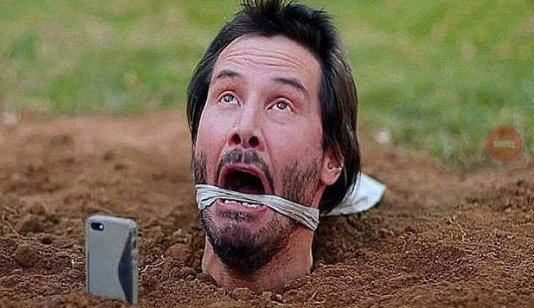
The picture comes from the film “Knock Knock,” which Eli Roth directed with Keanu Reeves and released in 2015. Reeves plays Evan Webber, an architect and family man. While his family is away, two young women come to his house. The story of hospitality gradually turns into manipulation and seizure of control over the homeowner.
Closer to the end, the heroines bury Evan up to his head and show him a phone. The threat is tied to publishing an intimate recording on Facebook and the consequences for his family. The frame was later used in Spanish-language remakes, and in Russian-speaking circles it appeared in 2017 and got a new wave in June 2018. The sole confirmed first author of the meme caption is unknown; the film's year is not the year of all these publications.
Head, fabric, and the back of the phone
The image shows Reeves's head in brown soil. A gray strip of fabric passes through his mouth; his mouth is wide open, and his eyes look upward. Grass is visible behind him. On the left, in the foreground, is a phone held close to his face. The viewer sees its gray back with the camera, while the screen faces the hero. Therefore, the content of the screen cannot be read in this picture.
The composition emphasizes the loss of ability to move: the body is hidden by the soil, and the phone occupies the space right in front of the person. Normally a film viewer can look away from an unpleasant shot or close the app. Here the character's usual freedom is visually taken away. The plot explains why he ended up trapped, but a reaction meme can convey the state without retelling the whole thriller. Recognizability is enough from the collision of an immobile head and an imposed screen.
How a new caption replaces the object of viewing
In the meme remake, the question often sounds like this: what is so unbearable that you'd be forced to watch it while buried in the ground? The answer might be a silly video, a story that goes on too long, or someone else's presentation. The caption makes the object of viewing visible to the audience, even though the screen in the photo faces another direction. This is a conventional substitution of the plot content, not a claim that the film showed the thing named.
The exaggeration works because of the huge gap between the on-screen trap and an everyday irritant. Several minutes of someone else's monologue are depicted as a total loss of control. The inability to press the usual exit button also matters: the hero is left as the only listener who cannot leave. The reaction can express shame, shock, or fatigue from repetition. An open mouth alone does not establish a single emotion; the specific meaning arises from the situation the caption proposes.
Three invented mandatory viewings
One example: a novice player already understands the rules, but the tutorial character keeps on with a ten-minute explanation that cannot be skipped. The caption “I'm on the fifth story about the jump button” turns the phone into a window onto endless instruction. The hero wants to get to the action, but the format keeps him a listener. What's funny is not the rule itself, but the gap between its simplicity and the length of the imposed explanation.
Another variant: a friend shows vacation photos and gives a separate comment on each of the nearly identical shots. The meme marks a guest who failed to come up with a way to end the viewing. The third scenario: a person casually asked someone to review one work slide, and the colleague opened the whole presentation and started reading it from the first page. In each case, the trap moves from the thriller into a conversational situation. What holds the hero is not the ground, but an invitation already accepted, an unskippable screen, or social awkwardness that prevents ending the showing.