Cho goes to the market
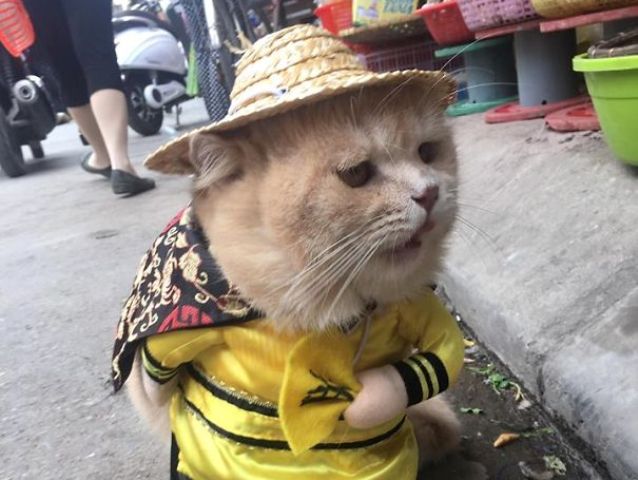
The cat belongs to Le Quoc Phong from Haiphong, Vietnam. In an interview the owner explained the unusual nickname by the pet's habit of sticking out its tongue, as a dog does. Phong photographed Cho in various outfits and posted the pictures on social media. Bright clothing and the calm expression of the little muzzle let each costume turn into a small story.
The market photographs became especially famous. The cat accompanied his owner and appeared beside stalls; in stories about him, the role of a fish seller took hold. His presence drew buyers' attention, and the photos gave viewers the chance to imagine the animal as a full-fledged worker. This description was part of humanizing Cho: posing beside merchandise turned into a comic shift at the counter.
The costume photos circulated as early as 2017, and in March 2018 the story of the market cat received wide international attention. In Russian-language captions he could become a stern boss or the hero of a joke about paws. These variants kept the real pet and his owner's photos at their core; the new lines already belonged to users who saw in the pose a fitting character.
A costume with hands of its own
Cho is shown outdoors in close-up. On his head is a woven hat with wide brims; on his body, a yellow costume with black trim. In front, human hands attached to the clothing are folded at his chest. A dark patterned cape lies over his shoulders. This is a more elaborate theatrical outfit than the simple yellow raincoat with which the meme's name is often associated.
In the background, passersby's legs, scooters and plastic containers near the stall are visible. There are no fish in this frame: the market is read through the street surroundings, and the role of a seller arises from Cho's general story. The decorative hands are especially important for the impression. The cat's head seems set on a small human figure that already knows how to stand with dignity and wait to be addressed.
A serious face takes up the post
The meme rests on the difference between a familiar cat and an invented social role. The hat and clothing promise a character with duties, obligations and a rank of his own. The muzzle remains feline and almost unperturbed. The viewer takes this impassivity for professional calm, although the meaning of the job is added by human imagination.
The costume with hands makes the pose especially suitable for a short dialogue. Cho can listen to a request, set a price or explain a rule with the air of someone nothing can surprise. The photo itself needs no alteration: it is enough to name the situation for the calm face to become the answer. The same pose accommodates an important manager, a tired employee and a wise neighbor alike.
The market story adds one more contrast. Normally a cat next to fish seems a potential thief of food. Here he is presented as the one responsible for the goods and for keeping order. The animal gets the opposite role, and the serious clothing helps one believe in this change for a second. Cho's conditional professionalism becomes a ready basis for new captions.
What roles can be invented for Cho
In an invented scene, the cat might be in charge of handing out house slippers. A guest asks for a bigger size, and Cho keeps an important expression and reports that only ones convenient for paws remain in stock. The theatrical costume turns a small household request into a conversation with an entire institution.
Another variant casts him as the organizer of a yard party. Everyone is looking for an organizer, and Cho appears in response, calmly waiting for people to finish arguing about music. The decorative hands look like a sign of patient waiting. The joke gives the small animal power over a noisy company that lacks the same composure.
In a third invented caption, the cat becomes an experienced umbrella seller. A buyer asks whether it will rain, and he replies that a good umbrella is also useful for looking important. The outfit here matches the product theme, but the seriousness of the offer deliberately exceeds its practical use. The ready pose ties these roles together: Cho looks as if he already knows the answer and is just waiting for the next question.