A character with a book backstory
Labubu is a character created by the artist and illustrator Kasing Lung, who appears in his fairy-tale world, The Monsters. The character's official history ties it to a book universe and to the year 2015; Lung built his characters drawing on fairy-tale imagery and his own drawings. This sets Labubu apart from an internet character that originally started out as a random photo or caption: here, an original piece of artwork came first, and only later did it become a collectible object and a mass visual symbol. The exact backstory of every meme variation can't be reduced to a single book or toy.
A design that's easy to recognize
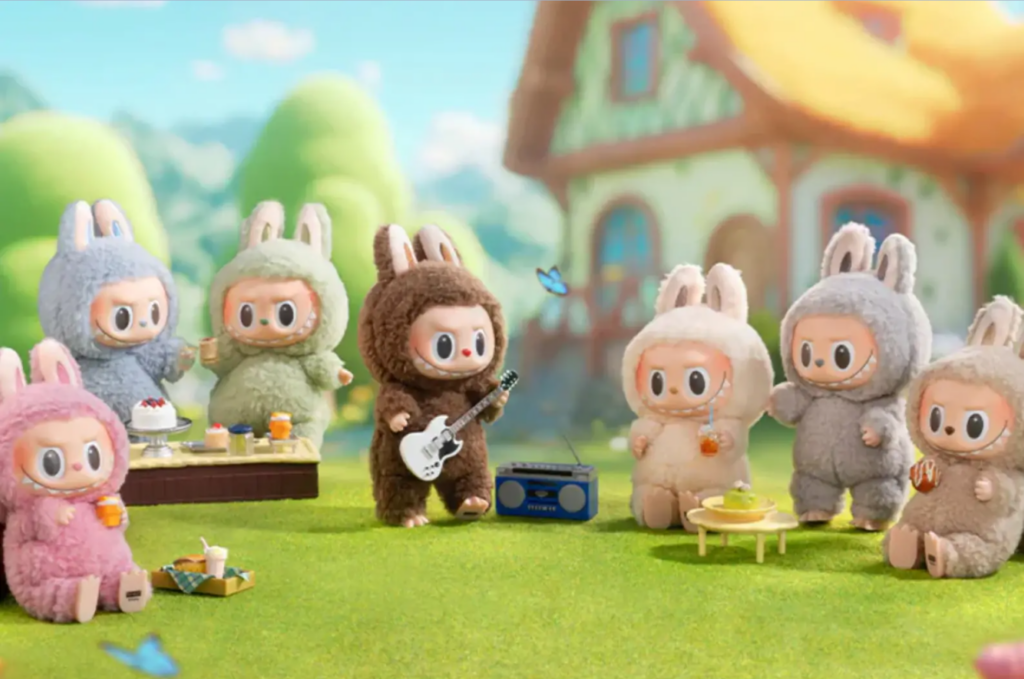
The character has pointed ears, big eyes, a smile with small teeth, and a deliberately mischievous look. The image shows a whole group of figurines or plush toys in different outfits on a bright, stylized lawn. The repeating face keeps it recognizable, while the variety of colors, outfits, and poses makes it easy to invent a story about a group, a collection, or yet another 'rare' version. Its visual appeal rests on a combination of cute and slightly strange: the character is friendly, but its toothy smile doesn't look like a standard doll's smile.
How the meme works
Labubu can serve as the subject of a caption, a marker of collector enthusiasm, or a notional participant in an everyday scene. Collectible releases are often sold as blind boxes, where the buyer doesn't know in advance which variant they'll get. This mechanism of anticipation easily turns into a joke about chance, luck, and the drive to complete a set: luck decides which of the already-familiar outfits ends up in the buyer's hands. That said, not every picture with the character is necessarily about a purchase: the design's broad recognizability lets a meme be built without knowing the specific line or price. It's better to play on the collector's experience than to advertise the product. The anticipation of a rare specimen is easy to compare to a small lottery.
Two original examples
'Me: I'll just get one. My shelf a month later: a tenants' meeting.' The group image turns a personal purchase into a small census. The joke runs on a collector's familiar exaggeration: the word 'one' quietly balloons into an entire community. This version suits people who already understand the urge to collect characters; outside that context it just states that there are a lot of figurines.
'Opened a blind box — now I have a mysterious accountant in a rabbit costume.' The contrast between a serious profession and an eccentric appearance creates its own separate comic image. The caption turns the toy into an imagined character without attributing a nonexistent biography to the official Labubu. This approach works especially well when the picture shows several different outfits and you want to give each one its own role.
Using it with respect for authorship
The template works best in communities where the audience recognizes the distinctive ears and toothy smile: in conversations about collections, gifts, surprises, and small everyday 'monsters.' A caption lands harder when it sticks to one detail — the toothy smile, a specific outfit, or the blind-box mechanic itself — rather than listing every color and version in a row. The character's origin shouldn't be conflated with the popularity of its toys, nor should it be claimed that viral interest created the character itself. Labubu has a specific author and an artistic history, so it's accurate to call it an authored character rather than a nameless internet toy.