First came a sticker set
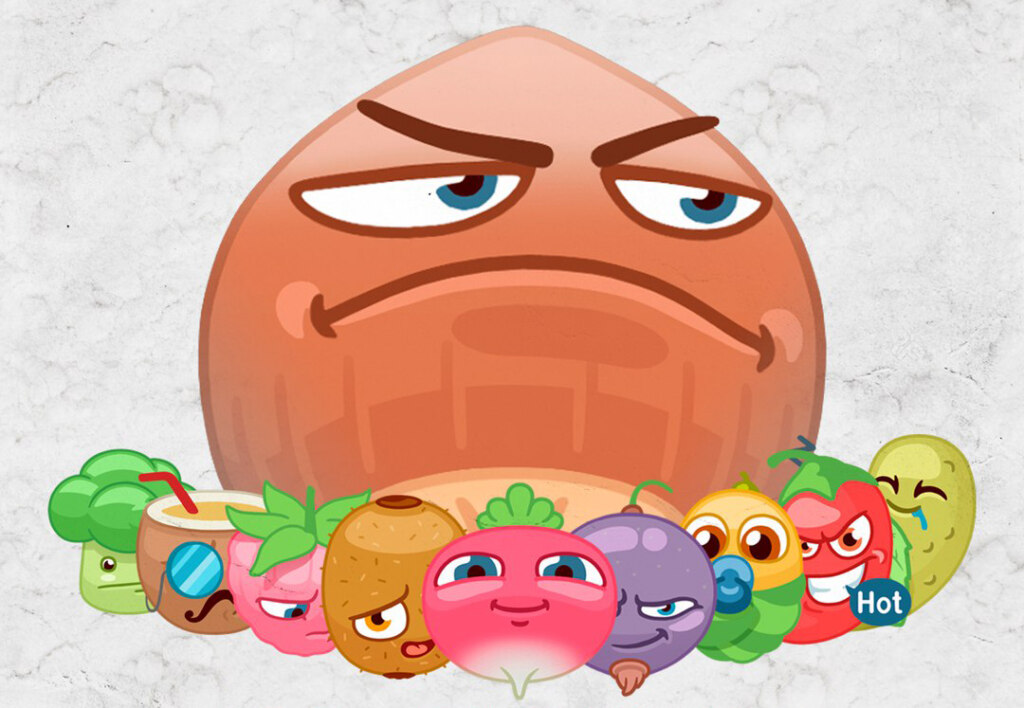
Orekhus first appeared in the VKontakte set “Fruitovoshchi,” developed by illustrator Andrey Yakovenko. The set has about forty anthropomorphic fruits and vegetables; the original Orekhus resembles an energetic face from international rage comics. That connection explains his pose and expression, but by itself it does not yet equal the Russian meaning “Spravedlivo.”
In 2015, administrator Danil Gordin began collecting comics from the sticker-pack characters in VKontakte’s built-in editor. According to him, the idea arose spontaneously, and the new community gathered around three thousand subscribers in its first days without any advertising. Later, readers also began making similar comics; the characters spread to other public pages and received short lines. Orekhus became attached to the word “Spravedlivo,” but the exact day this pairing appeared has not been established.
What is actually depicted
Orekhus takes up almost the entire upper part of the picture: heavy eyebrows and a downturned mouth give him an angry look. Beneath him, small fruit-and-vegetable characters are packed tightly together; at the right edge of one of them a “Hot” label can be seen. The enormous face differs sharply from the others in scale and draws the eye, but the image has no speech bubbles or separate sequence of actions.
The contrast between one large character and a whole company below is especially noticeable here. The pink character looks straight at the viewer, the purple one sticks out its tongue, and the one on the far right smiles; their varied faces form a chorus against the nut’s heavy grimace. A familiar sticker can be read as a reaction, but in this composition it becomes more of a main character in a group portrait. There is no caption on the picture, so the link to the phrase “Spravedlivo” comes through the familiar image and the added context.
From “cool” to “fair”
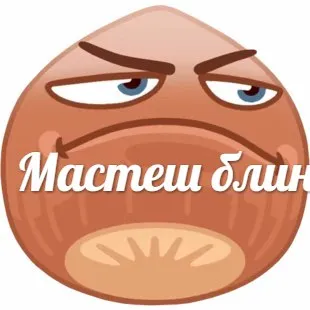
In the original English-language tradition, a similar grimacing character expressed satisfaction or triumph. In Russian-language comics the reaction shifted: Orekhus began approving someone else’s argument and often appeared next to the word “Spravedlivo.” This is no longer simply self-satisfaction. The character seems to deliver a brief verdict: what was said looks convincing or deserves agreement.
The combination of word and grimace sets the tone more precisely than a face alone. After a reasonable argument, “Spravedlivo” sounds like direct agreement; after an all-too-obvious moral, the same stern character turns approval into dry irony. In the group illustration the effect is different: before reading any single caption, the viewer notices how the big angry nut dominates the whole company.
Invented captions
Invented caption: “If you took someone else’s charger, return it to the same outlet with the same adapter — fair.” Orekhus marks a simple rule of reciprocity.
Invented caption: “We ordered a shared dessert; whoever picked the flavor hands the first spoonful to everyone else.” Under Orekhus’s stern gaze, an ordinary arrangement sounds like a decree.
Invented caption: “The team postponed the release until they restore the backup.” The word can be a serious endorsement of the decision or an ironic stamp if the reason is deliberately trivial.