The knife as the hero of an advertising legend
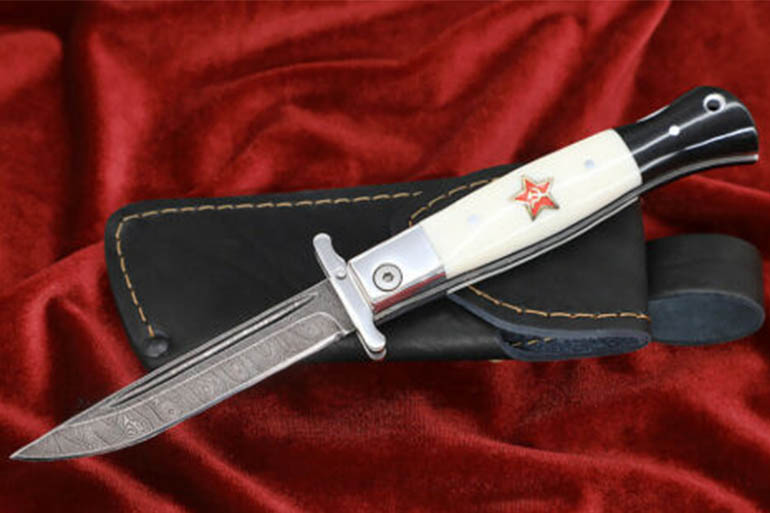
The image shows not a historical photograph but an illustration of a knife: a long blade, a contrasting handle, and a red background give the object the look of an action-movie artifact. Captions usually play on the deliberately pompous name "the NKVD finka." The image itself is no proof that the specific knife shown belonged to agency staff or was used in any operation.
Historical background calls for caution. Finnish-type knives and the Soviet scout knife NR-40 did exist, but the modern commercial formula "that very legendary finka" often blends different models, periods, and legends together. A specialized outlet breaks down the differences between Finnish knives, Soviet-issue models, and commercial replicas. So the meme is better read as mockery of an advertising myth rather than as a museum attribution of the object.
How an ad turned into a shared joke
In the 2010s, Russian-language internet regularly featured ads promising a special finka with a grandiose historical epithet. The repetitiveness of the pitch made it recognizable: the knife seemed to be advertised on every corner, and the word "legendary" sounded like a ready-made comic cliché. In 2022 this image spread noticeably again in meme posts, but it's hard to reliably establish a single author or the specific first ad banner.
The meme grew out of the mismatch between the dramatic red backdrop of the ad image and the ordinary commercial messaging behind it. The more solemn the tale of an exceptional blade, the funnier its appearance in an everyday situation becomes — as if the seller were ready to explain buying bread as an episode of secret history. This isn't necessarily a critique of the particular knife's quality; the target of the joke is more often the persuasion style that pushes a legend instead of verifiable specs.
Where the hyperbolic pitch works
Example caption: "An ordinary letter opener. The legendary NKVD finka — opens a package that survived three sorting centers." The contrast between the grand title and a delivery box repeats the mechanics of the original joke. Another option: "A cheese knife forged in an era when the toaster was already considered a technological breakthrough." Here the comedy rests on a pseudo-historical description of a completely modern trifle.
You can carry the tone over to services and gadgets: "The legendary cable that charged a phone before phones even existed" or "That very mug the coffee makers stay quiet about." But when it comes to actual weapons and real people, it's better not to present ad tales as fact. The recognizable joke is built precisely on the legend's obvious implausibility, not on accusations or dangerous romanticizing of violence.
How to caption this particular picture
Keep the knife as the main subject and make the text short: a long story would eat up the contrast between the image's grandiosity and the mundane occasion. The scheme "ordinary task — the object's incredible biography" works best: a purchase, unwrapping a package, slicing an apple, or trying to fix a toy. The red background already supplies the drama, so the caption can stay dry.
If you want to make an edit, you can place the knife in an obviously absurd role — say, as the "official tool for opening a letter from the management company." Don't add invented dates, units, or owners' names: that turns a parody into a false historical claim. The template lands hardest when the legendary status is obviously exaggerated and the stated task is pointedly modest.