What's shown in the picture
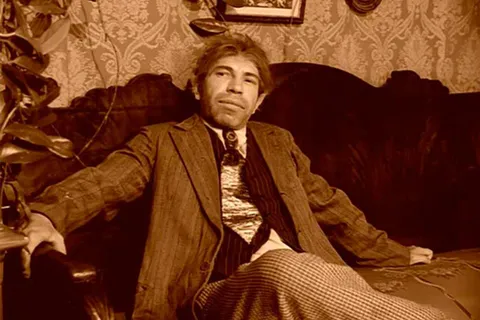
In the low-quality frame, grainy in the manner typical of video from that era, a balding man with a small beard, wearing a dark jacket and tie, is visible. He's sitting against a backdrop of large mushrooms with red, white-spotted caps resembling fly agaric. The bright background and the man's serious pose create the contrast that forms the basis of the joke: the man looks respectable, but his surroundings plainly underscore the absurdity of what's happening.
The frame itself looks like a still from a broadcast segment where a host or interviewee lays out a claim without a trace of a smile. It's exactly this absence of irony in the delivery that makes the picture funny: the viewer sees the familiar seriousness of television and, at the same time, understands the subject is sheer nonsense.
Origin and history
The joke traces back to a 1991 television segment in which the claim that Lenin is a mushroom was presented in earnest. The specific program, channel, and the segment's author are unknown. Many details of this kind get lost over time, and recordings survive only in fragments.
The segment appeared during a transitional period, when Soviet television and the mass press were only beginning to change. Viewers were accustomed to an official style of presentation, in which anything shown on screen was taken as reliable. So a serious tone in a journalistic or documentary story could make the audience believe even an obviously absurd idea, and it's exactly this clash that became the subject of irony.
Over time the phrase broke away from the specific segment and began living its own life in internet discussions. Users started recalling the recording as an example of how easily television can make a viewer believe anything, given the right delivery. That's how a brief broadcast episode turned into a universal metaphor for manipulation and media hypnosis.
How the meme is used
The phrase usually comes across as an ironic reply to doubt. If someone confidently states something questionable, the other person might respond: "Lenin is a mushroom, and that's not up for discussion." Such a reply underscores that the claim was delivered with the same unshakable confidence that once convinced people of the TV segment.
In picture captions, the phrase often accompanies images of Lenin himself or of mushrooms, or serves as a joke caption for screenshots from broadcasts. Sometimes it's added to news items or posts that present dubious facts with an air of importance. In this way the meme works as a brief comment on how credible the delivery is.
There's also a more detached usage: the phrase comes up in conversations about media literacy. It's a reminder that the form of delivery can matter more than the content, and that a serious tone doesn't guarantee truthfulness. In this context, the meme sounds less like a joke and more like a warning that's easy to remember.
Why the meme works
The joke's main mechanism is the gap between the seriousness of the tone and the absurdity of the content. When someone lays out something that's clearly impossible in an official style, a comic effect arises. The viewer realizes they're being pranked, and that very realization becomes the source of the laughter. That's why the meme works even for readers who don't know the details of the broadcast segment.
The second reason is brevity. The phrase is three words long, easy to remember and repeat. Such a format is ideally suited to internet communication, where instant recognizability matters. The short formula transfers easily to different contexts and needs no explanation — mentioning Lenin and a mushroom is enough for the other person to get the hint.
Finally, the meme taps into a shared memory of how television works. Many people are familiar with the feeling that something shown on screen sounds convincing only because it was delivered with confidence. The joke lets people laugh about that experience while also serving as a reminder to check information, even when it's presented with complete seriousness.