What is visible in the frame
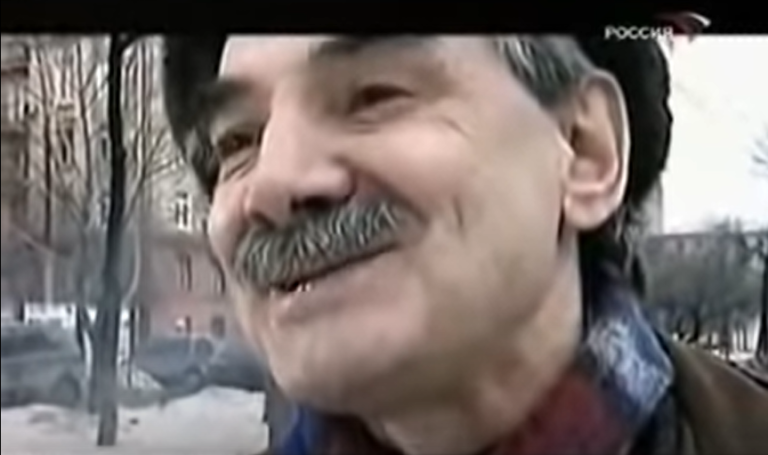
The image shows an older man in a dark knit cap, with a gray mustache and a smile, being interviewed on the street in winter. In the background are bare trees, residential buildings, and parked cars, typical of a residential district. The logo of the Russian TV channel “Rossiya” appears in the top right corner, indicating that the fragment comes from an on-air television segment rather than an internet video.
The man looks exactly like a street-interview subject, a passerby being asked questions, so the frame originates in a TV news-style piece rather than a scripted comedy scene.
Connection to Alexander Pankratov-Chorny
The catalog links the phrase and the frame to a humorous video featuring Soviet and Russian actor Alexander Pankratov-Chorny, known for many comedy roles in 1980s and 1990s films and for regular appearances on comedy TV shows and sketch programs. In this context, “da ya zh poshutil” reads as a line typical of his comedic persona: a reply with a sly grin after a provocative or ambiguous remark, when the other person or the audience takes it too seriously.
Origin and circumstances
Details of the original segment, including the specific program, air date, and exact context in which the phrase was said, are not unambiguously confirmed. The meme's appearance is dated to 2018 and to YouTube, where the television clip apparently spread as a standalone video. The television origin is therefore only approximately established, and the exact program and air year of the interview remain unknown.
How the phrase became a standalone meme
Separated from the original video, “da ya zh poshutil” began to live a life of its own as a universal tension-breaker. It accompanies screenshots of chats, comments under controversial posts, and any situation where the author tries to soften the reaction to their words by retroactively reducing them to a harmless joke. A typical example: first a blunt or provocative statement is posted, then, as a separate message or in a caption on the same picture, “da ya zh poshutil” is added as an attempt to give oneself a way out.
This two-step joke, provocation first and then excuse, makes the meme a handy tool especially for text chats and comments, not only as an illustration for a video.
Typical captions and contexts
Common examples include “telling my boss he looks great today, oh, I was just joking” or “texting my ex ‘how are you?’ at 3 a.m., oh, I was just joking,” where the picture of the smiling TV character serves as an illustration for the final, face-saving line.
Thanks to the character’s recognizable, expressive face, the frame reads without extra text: the smile alone conveys the tone of condescending self-irony, which is why the image has had such a long life as a standalone reaction meme.