Origin of the comic
The comic's creator is the New Zealand artist Kim Casali (born Marilyn Judith Grove). In the late 1960s she hand-drew black-and-white love-note cards for her future husband Roberto Casali, an Italian engineer whom she had met in Los Angeles in 1967. Each drawing was accompanied by a caption beginning with the words "Love is...". The first installment of the comic ran in the Los Angeles Times on January 5, 1970, under the pseudonym Kim. It was later published in newspapers in roughly fifty countries.
After Roberto was diagnosed with cancer in 1975, Casali hired the artist Bill Asprey, who continued drawing the comic under her signature and still does. According to one source, Asprey created a colored version in 1978 for the British newspaper Mail on Sunday. Casali herself died in 1997.
Intergum gum and the inserts
The comic became widely known in the countries of the former USSR not through a newspaper but through chewing gum. The Turkish company Intergum produced "Love is" chewing gum with inserts that featured scenes from the comic. Reportedly, eight flavors were released in the 1990s, pairing the flavors of two fruits, for example strawberry with banana or cherry with lemon. One source dates the gum's appearance in Russia to 1990 and notes that it took a notable share of the market.
The inserts turned out to be more important than the gum itself. The company used Asprey's drawings without permission, and, according to a report in the catalog, the artist only learned that his work was being packed into gum in 2008. In the early 2000s Intergum's share began to fall: the market was divided between Wrigley and Dandy, then Cadbury Schweppes bought Dandy and announced its purchase of Intergum in 2006. The gum gradually disappeared from shelves, and around 2008 it reappeared in metro stations, shopping centers and stores. Sources differ on the details, so the exact dates here should be treated as approximate.
The caption formula
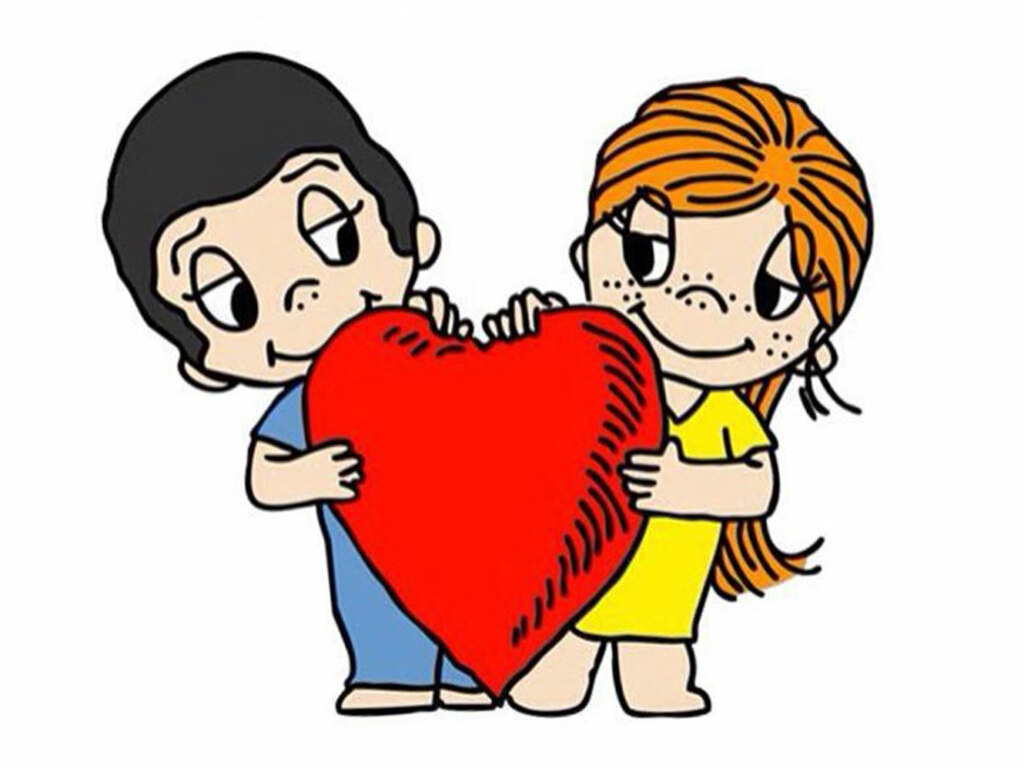
Each card is built on a single pattern: a short line beginning with "Love is..." and a picture that either confirms it or gently turns it on its head. The characters barely speak, so the caption carries the meaning. The tone ranges from sentimental to sarcastic, and it is this range that made the comic convenient for postcards and inserts. One frequently quoted caption reads: "Love is when two people are already a couple." In the same vein, one could imagine another: "Love is splitting the last pie in half, even if it's already been bitten."
The characters are drawn deliberately simply: round heads, small bodies, large eyes. This simplicity allowed faces and poses to be transferred to any storyline without losing recognizability, and with it the recognizability of the format itself.
The format's digital life
On the internet the comic took hold thanks to VKontakte and the blogs of the 2000s and 2010s, where users began drawing their own variations. The pot-bellied boy and girl with thin lines became a template for any stories about romance, jealousy, quarrels and shopping trips together. Many variants repeat the structure, but their captions often poke fun at the genre of relationship messaging itself.
Remakes and templates spread the same way as other picture templates: without credit to an author and without a link to the original source. That is why what usually surfaces in the feed is not Casali's series itself but its memory, reworked by dozens of hands.
Why the format outlasted the gum
The main reason for its durability is nostalgia. For people who grew up in the 1990s, a gum insert is tied to the first school swap, and the picture is recognized before the caption is even read. The second factor is compactness: two characters, one phrase and a simple composition fit easily into a postcard, an avatar and a post.
The third factor is the universality of the theme. Relationships change little, so any new caption still works. Comparison with other classic drawn couples shows that Love Is has a specific visual code, not just a general aesthetic of "cute pictures." It is this code that allows the meme to exist apart from the gum, which is no longer on the shelves.