What's shown in the photo
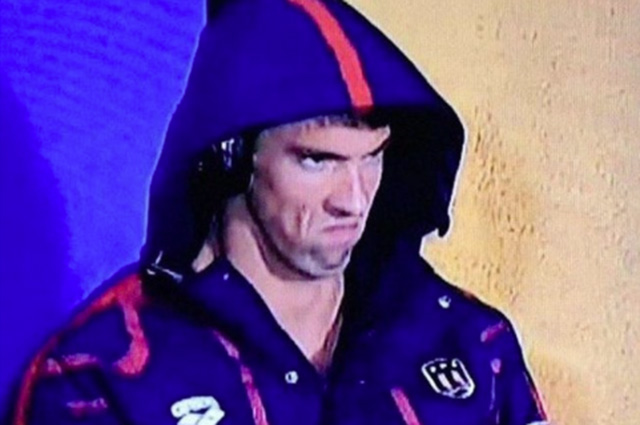
The photograph shows the athlete in a blue hooded tracksuit jacket trimmed with a red stripe. His face is drawn toward the bridge of his nose, his brows furrowed, his lips pressed tightly together, and his gaze directed away from the camera. The background is blurred, with a beige wall and part of a blue surface visible behind him.
His expression reads as extreme displeasure or hidden menace. At the same time, Phelps says nothing and makes no gestures: the emotion is conveyed purely through facial expression. It's exactly this silence that made the frame so expressive, since the viewer fills in the meaning themselves and feels the tension.
The shot is typical of elite sport: an athlete focused before the start or after a race, with the hood emphasizing isolation and concentration. That's why the image reads easily both as a professional's seriousness and as literal anger, and this became the basis for the meme.
History and spread
The photograph is tied to the 2016 Olympic Games in Rio de Janeiro, held in August 2016. It was reported that Phelps's gaze was directed at South African swimmer Chad le Clos, with whom the athlete was competing in the event. The frame quickly spread across TV channels and the internet, and some outlets called it the meme of the moment.
Within just a few days, American media were running pieces about "Phelps Face," and the hashtag #PhelpsFace appeared on social media. Users began creating edits inserting the swimmer's face into everyday scenes, sports, and cartoons, and the grimace itself became a recognizable gesture for expressing displeasure.
The spread was helped along by the activity of sports outlets and news sites themselves, which regularly played on the image in headlines. The meme quickly moved beyond sports and became part of the shared internet language. The exact author of the specific frame is not named in the article, since that information has not been reliably confirmed in open sources.
Typical use
Most often, "angry Phelps" is used as a reaction to an irritating situation. The grimace suits describing displeasure with a line, an unpleasant letter, or a pestering interlocutor, and the caption is usually built on the pattern "when..." or "my response to..."
The image is also used in sports discussions: fans post it after a losing match, a failed training session, or a questionable referee's call. Sometimes the joke is carried over into personal situations, such as exhaustion at work or irritation in traffic.
In an ironic vein, the meme is also used for self-description: a person posts the grimace to explain that they're focused or not in the mood to talk. This usage stays friendly, because the joke isn't aimed at any specific person but relies on a universally recognizable emotion.
Why the meme works
The main comic effect is based on the contrast between the official image of an Olympic champion and an everyday emotion. A serious athlete in a hood looks both focused and displeased at once, and the viewer easily maps that state onto their own situations.
The visual language matters too: drawn-together brows, pressed lips, and a sideways glance create a recognizable mask that's easy to reproduce and reads without a caption. The meme also rests on the fact that there are no gestures or speech in the shot, so the caption can be anything.
Finally, interest in the image was fueled by mass media, which turned the frame into news in its own right. Thanks to this, the grimace became an understandable code for focus and irritation, and its positive reading as concentration on a goal also survived, which makes the meme ambiguous.