The structure of the comic
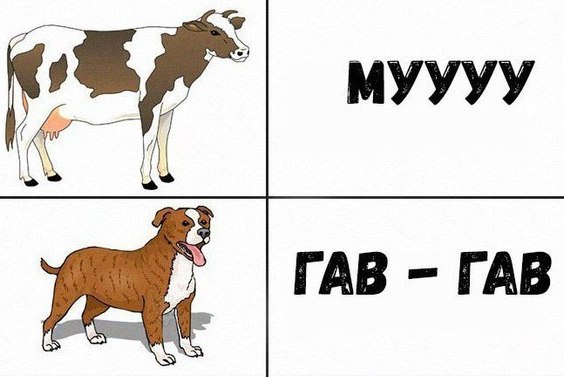
The comic is built as a grid of identical cells. In the top pair, a brown-and-white cow is drawn, with "MOOO" written next to it in large letters. In the bottom pair, a dog resembling a Staffordshire terrier is depicted with the caption "WOOF — WOOF." The drawings are simple and neutral, and the text is large and high-contrast, so the joke registers within a second.
The following cells, according to the description in the source section, continue the same pattern: a rat depicts a person ready to betray a friend, and a snake depicts a scene of a man and a woman quarreling. These fragments rely on recognizable animal behaviors and transfer them onto human conflicts.
Origin
The exact author of the comic and the first person to publish it are not known. Similar pictures, in which animals make sounds, spread through social networks and humor communities in the 2010s, where the format of "a simple picture, an unexpected conclusion" was popular. The meme dates to 2017.
The format recalls classic captions like "cats say meow, and people...": this is a device that is easily reworked for any topic and requires no special skill to create new versions.
The mechanics of the joke
The point rests on a bait-and-switch. The viewer first sees the familiar "moo" and "woof-woof" and expects a simple children's picture. Then a harsh scene of human behavior appears, and the joke turns sharp, though still harmless in tone.
The comic also works as satire on human vices: betrayal, squabbles, and petty meanness. The animals serve as a convenient mask, since they allow people to be talked about without addressing anyone directly, and therefore without offense or conflict with specific interlocutors.
Use and variants
The picture is used for comments about colleagues, acquaintances, or situations in general, without naming specific people. It is also taken as a template for original versions with other animals. There are many variants: the pairs of animals and the scenes change, but the pattern stays the same.
In communities the meme is often posted with a caption that refers to a specific situation, so the meaning of the picture keeps being refreshed, while the template itself continues to live on in new contexts.
Conclusions
The "animal sounds" meme is interesting as an example of a simple template that works on contrast. It requires no knowledge of context, which means it easily survives generations of users and keeps appearing in new reworkings.
An important trait of the genre is the balance between a soft form and a sharp content. The drawings are childlike and harmless, while the punchline can turn out quite biting. Thanks to this, the comic is convenient to use in friendly discussions: it conveys criticism of human weaknesses without direct accusations and without pointing a finger at anyone, so it is rarely taken as aggression.
The pattern also easily transfers to new pairs of animals: a cat and a mouse, a goose and a duck, a fox and a hen. Each variant keeps the structure of a sound followed by a punchline, which means the template remains recognizable even to those seeing it for the first time. That is exactly why comics of this type keep appearing in communities even many years after their first publication.