What the photo shows
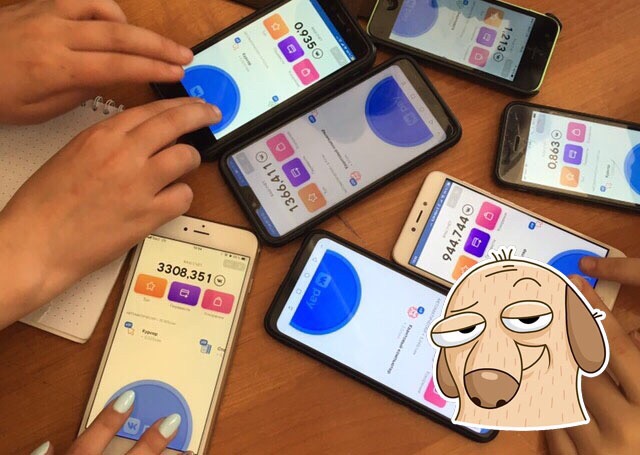
The photo was taken over a wooden table: several smartphones lie around, and the same interface is open on their screens, with a large blue circle and colored buttons nearby. Hands with different manicures touch the screens, and a spiral notebook is visible on the left. The balances on the screens are shown as decimal numbers with three digits after the point.
In the bottom right corner, a sticker is laid over the photo: a drawn dog with half-closed eyes and a bored expression. The scene looks like a competitive frenzy, but the character watches it without any enthusiasm, and this gap is what makes the picture funny.
How the service launched
VK Coin opened on April 1, 2019, right inside VKontakte. It works as a clicker: taps on the button bring coins, which can be spent on upgrades that speed up earnings and sent to other participants. The game had a ranking of the richest users. The launch date coincided with April Fools' Day, so many people took it for a prank.
Growth was fast. According to the specialized press, within a few weeks more than ten million people were using the service, and the richest player's balance passed 47 billion coins. It was the speed, rather than the coins themselves, that made the launch noticeable.
Coins that were exchanged for money
The most discussed part of the story concerns exchanging coins for rubles. According to reports at the time, users began selling coins to each other for real money, and an unofficial market formed around the game. A project representative said the company did not intend to ban it and considered such deals a private matter for the participants.
Coins could be used inside the service and in small payments between people. That is why descriptions of VK Coin are best tied to a specific period: the rules and features changed as the project developed, and a single line such as “the coins can't be spent on anything” does not describe it accurately.
Four captions on one contrast
Captions for this kind of picture rely on the gap between a huge number and a small everyday reality. Here are four independent variants.
“A balance in the billions, and not enough for a coffee.” The numbers are huge, and the joke brings them down to everyday scale, where the coins buy nothing.
“I tap the blue circle instead of an alarm clock, motivation zero point one thousandth.” A tiny sum for each action emphasizes how pointless the repetition is, and the exact figure works better than a rounded one.
“Selling coins for real rubles, no guarantees on the deal.” This variant draws on the exchange story: it sounds confident, though there is no reason for confidence, and that contrast creates the comedy.
“I expected the coins to become money, and they became a click.” The pause before the last word flips the expectation: the reader waits for a payoff and gets an action with no result.
When the template fits
The picture suits stories about overvalued digital currencies, useless bonuses, and games where progress is measured by repetitive clicks. It is better not to tie it to specific participants in the exchange: the joke targets the service itself and its mechanics, not individual people.
If a caption is based on a real story, stick to the facts: it is best to state the launch date, the description of the mechanics, and the company's position on the exchange precisely, so the caption does not diverge from what actually happened.