Image
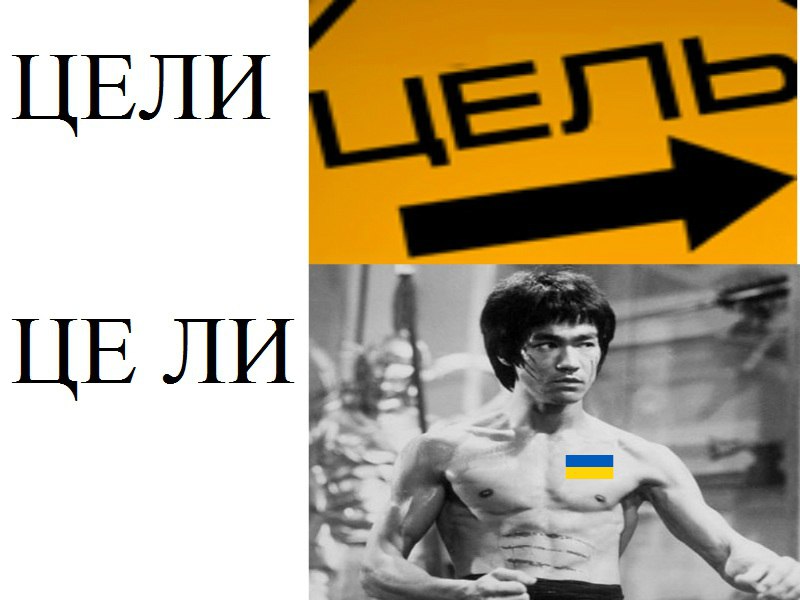
The image is split into two parts. The top part contains the word "TSELI" on a white background and a yellow road sign reading "TSEL'" ("GOAL") with an arrow. The bottom part consists of the word "TSE LI" on a white background and a black-and-white photo of a shirtless man with the flag of Ukraine painted on his chest.
The composition joins two blocks of text with two images. The road sign is linked to the first word by its root, so the connection between the word and the image is built through a visual reference.
Mechanics of the genre
The genre is built on splitting a Russian word into parts. The first part, "tse," matches the word that means "this" in Ukrainian. The second part is presented as a stand-alone word meant to sound like a translation. That is how "tseli" turns into "tse li," as if it were two separate words.
The catalog's description notes that this kind of meme often produces pseudo-translations. The reason is that Ukrainian words sound and are spelled differently, so pairs chosen for their similarity in sound don't correspond to actual vocabulary.
Judging by the catalog's description, similar techniques of splitting a word into similar-sounding parts also appear in other language games on the Russian internet, but it was specifically the version with a pseudo-translation into Ukrainian that got its own name and came to be seen as a genre in its own right, rather than a one-off joke.
Origin
The genre's origin could not be established. A search turned up no source describing who first used this technique or when it became widespread. The origin remains unknown.
The meme dates to 2017, probably the time when the genre spread widely. The technique, based on similar-sounding words, is known outside this genre as well, so there is no basis for naming a single author.
Linguistic basis and perception
Memes of this type rely on the idea that Russian and Ukrainian are closely related languages. That closeness is real in terms of vocabulary, but it doesn't mean words coincide in meaning and sound, which is exactly what makes the pseudo-translations a subject of irony.
For the reader of the encyclopedia, it's important to distinguish between a play on similar sounds and an actual translation. The meme works as a game, not as a language lesson, and its meaning doesn't come down to conveying the words' actual sense.
It appears that the appeal of this technique lies in the fact that it doesn't require any knowledge of Ukrainian: it's enough to split a word into syllables so that the first part resembles a short Ukrainian word, while everything else is taken as a joke regardless of the actual translation.
A note on the image
The catalog's description states that the second part of the pair sounds similar to a Ukrainian word. In the illustration, however, the word is split into "tse" and "li," and here "li" functions as a separate syllable rather than a chosen Ukrainian equivalent. The pair "tse li" shows a word being split, not a translation, and readers should keep this discrepancy in mind.