Three people against a gray background
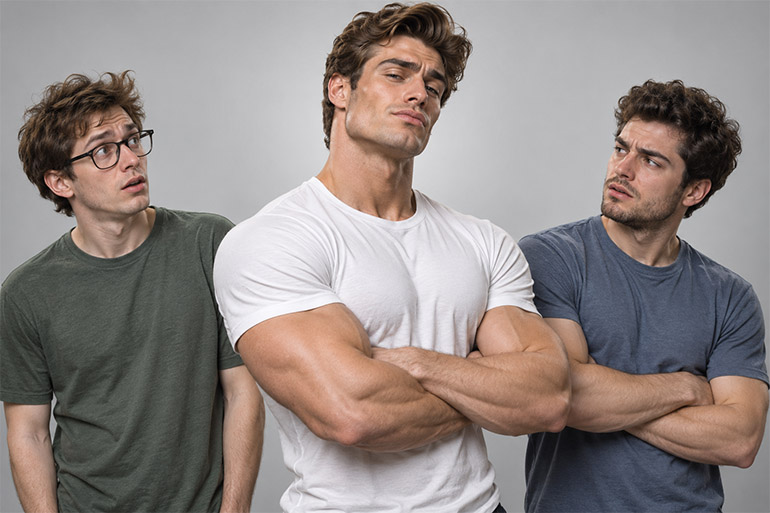
The picture has no captions or effects — just three people against a plain background. In the center stands a tall man in a white T-shirt, arms crossed over his chest, chin raised slightly, gaze tilted a bit upward. He takes up more of the frame and stands up straight.
On the left is a person in glasses, wearing a green T-shirt, somewhat shorter. He's looking up at his neighbor with an expression of uncertainty, as if sizing up how he looks next to him. On the right is a third person with curly hair: his arms are crossed the same way, but his look is skeptical, appraising.
The shot looks like a staged photo shoot rather than a random snapshot: all three have similar poses, even lighting, and a clean background. That's why the image is convenient to use as a template — it's already built around comparison.
Mogging: a word from English-language communities
The word comes from the English-language internet, where appearance was being discussed. The verb means "to outshine": to surpass another person in height, build, face, or confident bearing, while the noun refers to that superiority itself.
In Russian speech the forms "mognut'," "mogat'," "zamogat'" appeared. The comparative nature of the word is preserved: you can only "mog" someone. A single person in an empty room outshines no one.
The song 'I'm Mogging You' by the group Tsuyefa
In the summer of 2026 the word had a new wave: short videos picked it up, and on July 24 the track "I'm Mogging You" came out. It was released by the blogger collective Tsuyefa, whose members include Milana Nekrasova, Virsaviya, and LIZOGUB.
After the song, mogging started being used jokingly even outside communities that seriously discussed appearance. The verb, however, stayed comparative: the joke only works when there's a second person nearby.
Why the advantage is only visible side by side
The meme works on comparison. Just put people next to each other, and the viewer will rank them by how much they stand out, no arrows or explanations needed. The caption usually just assigns the roles: who did the outshining, and who ended up in the background.
Each of the two onlookers' reactions keeps the joke going in its own way: surprise reads as an admission of the other person's advantage, skepticism reads as arguing with it.
The theme of comparing appearance doesn't by itself make the joke kind: a caption can easily turn the confident protagonist into someone full of himself, and the onlooker into the voice of common sense. It's the wording, not the picture, that ends up gentle or cruel.
Captions where the comparison shows
"My desk, and the desk of my coworker who leaves at six." The difference is obvious at once: one has papers covering the whole desk, the other has an empty surface.
"Me and my planner after the first week of planning." Here the object outshines the person: the to-do list turned out more convincing than its owner.
"One app is updating while the other eleven wait their turn." The comparison plays out on a phone screen: one window takes all the attention, the rest stay in the background.
"My cat and me in the same room. Who outshines whom is still an open question." The caption leaves the argument unresolved, which suits the third character's skeptical look well.
What's visible in the shot
The shot already contains both sides of the comparison: the central figure and two onlookers with different reactions. The surprised look on the left supports an admission-style caption, the skeptical one on the right supports an argument-style caption that leaves the question open, as in the example about the cat.
The photo's author and the year it was taken are unknown: write-ups about the meme describe only the word's meaning and the song's history. The picture circulates in feeds with no caption and no credited author.