The song and its local reinterpretation
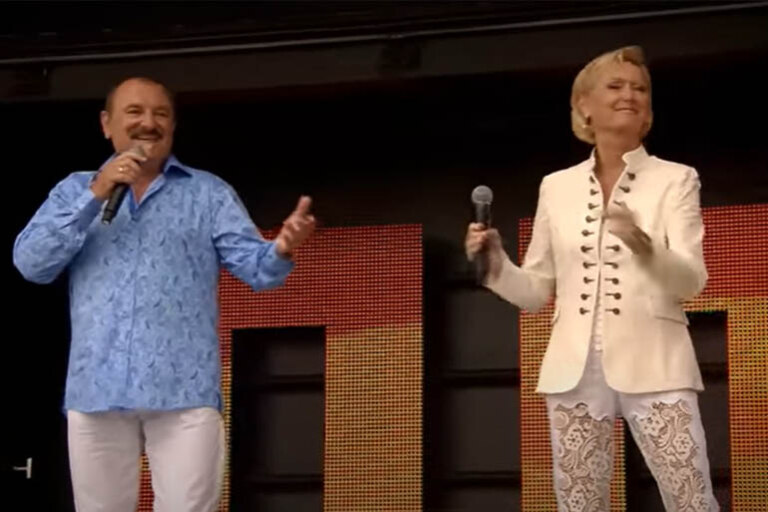
The local image shows performers in bright stage costumes. Behind the meme is the song “Goeiemorgen, morgen” (“Good Morning, Morning”), recorded by the Belgian duo Nicole & Hugo in 1971. In 2022 the old number unexpectedly got a new wave of short videos on Russian-language social networks. The sound of the Dutch phrase turned out to resemble an obscene expression, and users started singing along to a phonetic parody.
This is purely mishearing and wordplay, not a translation of the song's actual lyrics. The original contains no Russian profanity; the title greets the morning. One should not attribute to the performers any intention to create an obscene Russian version: the meaning arose with an audience speaking another language. Popular clips often use archival stage footage, but a specific frame in a local file does not allow one to establish the exact year of the recording or the venue.
The mechanics of the sound joke
The listener first recognizes the upbeat melody and the rhythmic repetition of the words, then substitutes familiar Russian sounds for them. The result is a collision between a friendly intonation and a crude imagined meaning. The contrast is heightened if the performers sing with broad smiles and festive energy. That is why the meme can work even without a translation: it is enough to hear the repeated fragment and see that the caption deliberately distorts it.
What matters is the difference between the audible original and what the viewer imagines it to be. If a literal decoding reads like a claim about the song or the Belgians, the meme loses its linguistic context. In a good-natured version, one can note that this is a phonetic joke for a Russian-speaking audience, keeping the original title without the vulgar substitution.
How an old number became a clip
The song was tied to Belgium's selection for the 1971 Eurovision Song Contest; after Nicole fell ill, other performers represented the country at the contest with the same number. This history helps explain why modern reposts feature different faces and archival recordings of the same number. The 2022 viral wave relied on available footage and a short musical excerpt that is easy to repeat or overlay on other scenes.
The 1971 Eurovision and the authorship of the later pun are separate stories: who first uttered the Russian mishearing on TikTok is not established. The existence of the song, its title and its performers, however, are confirmed by music and contest archives. The established musical history should therefore be kept separate from the floating history of remixes and user captions.
Examples of good-natured adaptation
For a family chat, one can caption an archival frame: “When you wish everyone a good morning and the auto-captions decide to joke on your behalf.” The joke then targets speech recognition. For a language class: “The teacher played the audio, and the class heard their own version of each line” — with the correct title of the song beside it. Both variants preserve the collision between what is heard and the actual text, without insulting the performers.
A short video might first show the original caption “Goeiemorgen, morgen,” then several variants of automatic subtitles with one clearly marked joke error. For example, “Good morning” becomes “the morning meeting has already started” — a safe reinterpretation for a work chat. Do not turn the phonetic error into a claim about Dutch or Belgian language: the meaning of the song remains an ordinary greeting.
If the publication is meant for a broad audience, it is better not to put the crude version on the cover and to add the original text alongside. That way adult viewers recognize the meme, and those encountering it for the first time do not have to take the jokey decoding for a genuine translation. The song can be used for jokes about getting up early, but its original meaning should be treated with respect.