The scene at the restaurant table
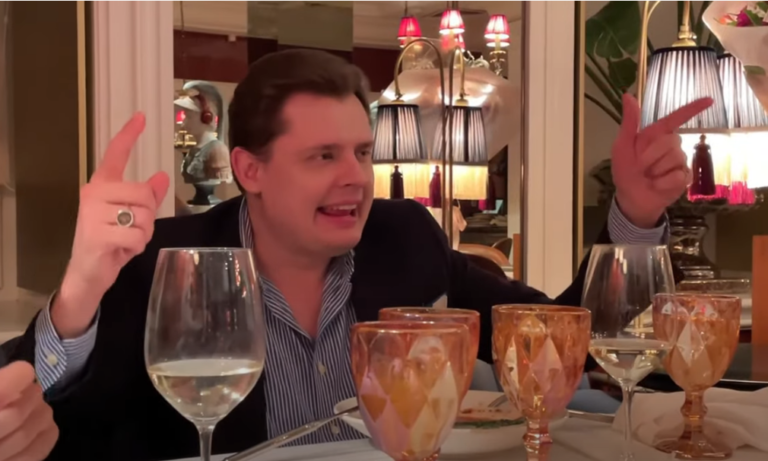
In the shot, a man in a dark jacket over a striped shirt sits at a set table. In front of him are glasses — one clear glass with white wine, others made of amber ribbed glass. Both hands are raised, index fingers pointed upward, mouth open: the man is clearly singing or speaking with great enthusiasm. Lampshades and ornate molding are visible in the background.
This is a shot taken from a video, not a finished template on its own: captions here are added above it or in the clip's description. A viewer can only tell what the man is singing if they already know the meme's backstory.
The song that became the trend's soundtrack
The track 'Gelato al cioccolato' is the title song of a 1979 album by the Italian singer Pupo (real name Enzo Ghinazzi). The lyrics were written by Cristiano Malgioglio, who credited his work on the album under a pseudonym. The album reached number 22 on the Italian chart. Pupo himself later said the song was inspired by the lyricist's adventure in North Africa, though Malgioglio denied this.
For Russian-speaking audiences, the song became recognizable specifically because of the clip with Ponasenkov, even though it had existed in Italy since the late 1970s.
Where the video came from and what the sources disagree on
The clip appeared online at the start of summer 2021, with the wave of TikTok jokes starting in early August. Accounts of its origin disagree: some reports say the video was posted on Ponasenkov's own YouTube channel, while others say it was uploaded to TikTok by a user named Alyona Valantyrets. Which version is correct hasn't been reliably established, so the discussion below covers only what matching reports confirm: the filming took place in a restaurant, and it spread widely on TikTok.
There were also reports of a ten-hour-long video made from this scene, and that Italian users created their own versions of the joke. The man's own stance on the meme is not known.
Why sincere joy works
The joke rests on the purity of the emotion. The man isn't performing fun for the camera — he's genuinely caught up in the song, and viewers read that as rare, real joy. Against the backdrop of TikTok's usual ironic delivery, this kind of directness looks almost touching.
The scene is also convenient for captions about an inner state: the hand movements and open mouth can easily be adapted to any occasion, from good news to a favorite song playing on the radio.
Example captions
The caption 'Me when that one song from childhood comes on in the store' captures the same situation as the original: unexpected joy at music you're ready to sing along to on the spot.
The caption 'Grandma, while grandpa's out in the garage with the guys' is taken from real variants of the trend and shows a different trick: the person in the shot is cast in someone else's role, and viewers guess the story from the facial expression alone.
The caption 'My conscience, after I turned off notifications' works as a contrast: the shot shows celebration, the caption a comfortable illusion that everything's fine.
The caption 'Friday, 6:01 PM' ties the emotion to a familiar moment and doesn't require knowing the meme's backstory.
How to use it
The meme works best in video form with the song's sound: a still frame loses part of the joke. For a still image, captions about joy without a cause, or about long-awaited good news, work well. The man shouldn't be linked to political statements or events from his biography: the joke concerns only the scene at the restaurant.