Stock mouse and a 2018 caption
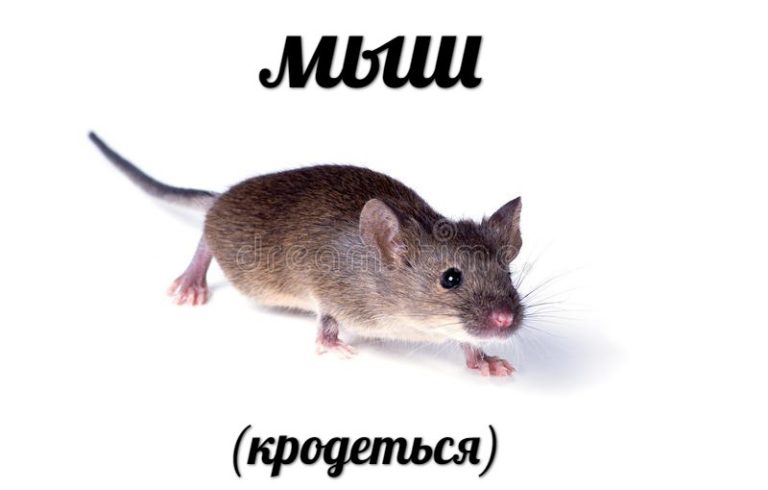
The photographic base is linked to a series by Irina Kozhemyakina, published in 2014: a small mouse on a light background shot from several angles. Reviews of the meme wave in the summer of 2018 pointed to this series and its description of movement. The author of the funny words was not identified separately. In the spring the picture circulated on VKontakte, and in July and August it became visible on social networks again; that is when the familiar construction began to be transferred onto new subjects.
In this version the mouse faces right, its tail curls up to the left, and all its paws are visible on the white surface. Above, in large italics, stands “Mysh,” and below, in parentheses, “(krodetsya).” A photo-bank watermark is visible on the fur. The photo has no dramatic action: the animal is simply in a pose that the caption declares to be a secret movement. In this way the ready-made image combines an ordinary photograph with its own distinctive narrative voice.
Error as a character's voice
The verb is misspelled, and the noun lacks its soft sign. Such text sets a deliberately naive voice, as if the mouse itself were commenting on the operation. The parentheses make the word resemble a stage direction in a script: first the object appears, then it is specified what it is doing. It is funny that a tiny creature performs an ordinary movement, but the caption presents it as a secret agent. Correcting the errors would remove an important part of the mechanism.
In December 2018, the linguist Vladimir Pakhomov cited this meme as an example of the return of deliberately distorted online spelling. Intent matters: the errors did not accidentally spoil the caption, they became its recognizable form. The italics look almost like a neat caption under a textbook illustration, so the wrong words stand out all the more. The result is a picture that tries to explain the obvious, but does so in its own funny language.
Sneaking up isn't just for animals
The format can show an event that gradually approaches: Monday, a test, old age, or a forgotten obligation. The mouse then is not a literal pest; it takes on the role of a quiet carrier of an upcoming inconvenience. The movement of the small animal turns out to be a fitting metaphor: the problem still seems harmless and distant, but will soon be close by. The caption states what is going on, and the parentheses add a theatrical stage direction.
In another variant, the character tries to act unnoticed on their own. Then the mouse's endearing size comically collides with the seriousness of the operation, such as the search for the last dessert. The corrected “the mouse sneaks” would convey the action but lose the voice. The careless grammar makes the miniature character a bit more important and self-assured than its appearance suggests.
Three new quiet appearances
“Monday (krodetsya)” above a mouse on a Sunday evening turns it into a calendar that is already creeping up on the reader. In a work chat, “One more edit (krodetsya)” leads up to a comment appearing after an announcement that the project is finished. The messenger's small size is funny: one edit promises to go unnoticed, but it can cancel all peace.
The third example is “I (krodetsya) to the last cookie.” Here the same little creature represents a participant in a nighttime snack, confident in their stealth. The caption makes the action secret, even though the picture shows the mouse fully and on an open white background. This failed disguise adds a second joke: the character tries to vanish from view while loudly telling the viewer what they are doing.