From an official report to an internet joke
The term appeared in Britain. It spread after the Social Exclusion Unit’s report of July 1999, “Bridging the Gap: New Opportunities for 16-18 year olds not in education, employment or training.” Before that, British documents used the closer wording “status zero.” It referred to young people who had already left school but were neither studying at university nor working.
The age limits vary. In Britain the category is usually described as ages 16–24, while Scottish authorities limit it to ages 16–19. This matters for understanding the joke: the term was originally a tool of statistics and policy, not a label for memes. On the internet, however, it became self-irony in the spirit of “technically here, but I’m not doing anything.”
The Japanese version and the word “nīto”
In Japan the abbreviation has its own definition: people roughly between 15 and 34 years old who do not work, do not keep house, do not study, and do not look for work. The borrowed word is written in katakana as ニート, hence “nīto.”
In the 2000s, the Japanese press wrote a lot about NEETs, and estimates of their number differ noticeably: figures include about 480,000 (September 2002), about 520,000 (September 2003), and 850,000 from a 2002 survey in which 60% were aged 25–34. The difference is explained by different definitions and counting methods, so there is no single exact figure.
What the picture shows
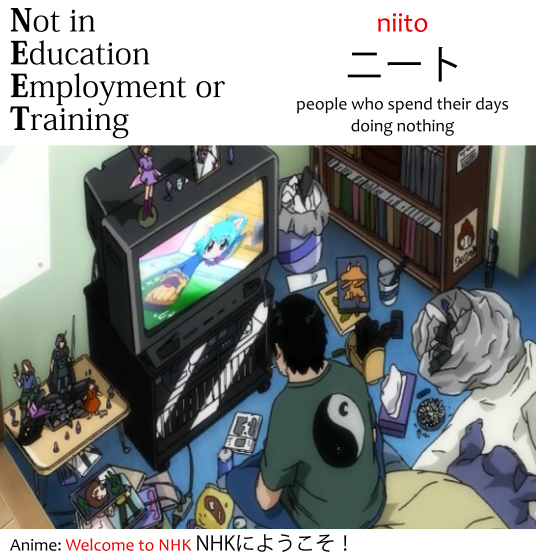
The picture is designed as a bilingual table. At the top left is the English expansion, Not in Education, Employment or Training; at the right is the red “niito,” the Japanese word ニート, and the caption “people who spend their days doing nothing.” Below is a frame from an anime: a young man in a green T-shirt with a yin-yang symbol on his back sits on the floor in front of a television, with papers, boxes, and figurines scattered around. On the screen is a bright character with turquoise hair.
The bottom line gives the title: “Anime: Welcome to NHK” and the Japanese “NHKにようこそ!”. This is an anime about social withdrawal that came out in 2006. The hero here is a fictional character, not a real person, so the joke is aimed at a way of life, not at a specific individual.
Caption examples
The examples all follow one pattern: an official definition is replaced by a personal, everyday confession.
“Officially not working and not studying, but in a week I rewatched three seasons and learned the opening theme by heart.” The funny part is the combination of bureaucratic wording with a simple admission about a hobby.
“My plan for the weekend: nothing, but completed one hundred percent.” The joke lies in turning the word “completed,” which normally means a result, into a sign of having nothing to do.
“Dream job: staying in touch with the fridge around the clock.” The contrast between a grand job title and an everyday action creates comedy, just as in the anime, where the hero barely leaves his room for almost the whole frame.
Self-irony instead of reproach
The meme rests on self-irony, not condemnation. The picture shows a person who calls their own state by a word from a report and accepts it with humor. That is why a caption is better written as a confession, not as a rebuke aimed at someone else.
If a joke concerns real people, especially young ones, it is worth remembering that behind the term stand statistics about living people with real circumstances: study, health, family, the job market. This does not make the topic off-limits, but it turns the joke from mockery into a conversation about oneself.