What can be seen in the frame
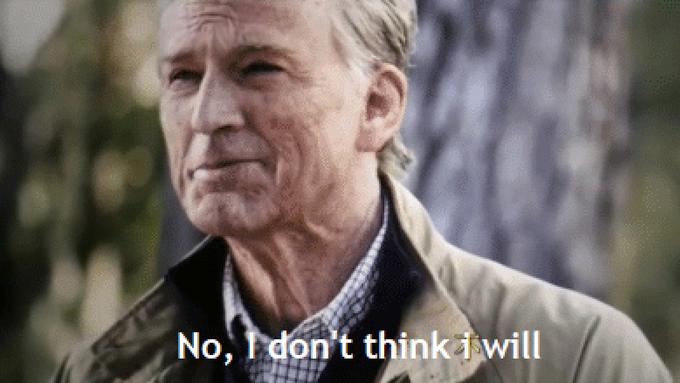
The frame is a close-up of an elderly man with light hair combed back and streaks of gray. He wears a beige jacket over a small-checked shirt. Behind him are blurred greenery and a tree trunk, so it is clear the action takes place outdoors.
His face is calm and somewhat reserved, his gaze drifts to the side, and his lips are pressed together in a slight half-smile. A white caption at the bottom reads “No, I don't think I will.” Without it the frame would look like a quiet scene, but the text turns the pause into a reply to a question the viewer cannot see.
The scene from the film
The line belongs to Steve Rogers, Captain America, played by Chris Evans, and is spoken in the finale of “Avengers: Endgame” (2019). In the epilogue Steve is already an older man, and this scene shows him after his return from the past.
Friends ask him how his personal life has turned out, and he calmly declines to tell them. The film does not turn this into a separate explanation, and it is precisely this light reticence that makes the line so suitable for jokes: it sounds gentle but leaves no room for further questions.
Why the refusal is funny
The joke works on contrast: the question is simple and friendly, and the answer is short and categorical, but not rude. Such a refusal sounds polite and unyielding at the same time, and the viewer recognizes their own conversations in it.
Another spring of the joke is expectation. After a long emotional film, the viewer expects an elaborate answer and gets a single phrase. The pause between the question and the “no” becomes the main part of the joke.
The phrase also fits other situations where a person does not want to talk about something personal: at home, at work, or among acquaintances. What is funny is not the refusal itself, but how calmly it sounds against the background of general curiosity.
Caption examples
A few invented variants.
“They asked how the vacation went, and I politely made it clear there would be no details.” An ordinary question gets an answer in the tone of an important secret.
“My colleagues want to hear the story about my car. No, I don't think I will.” The refusal applies even to the most boring stories, and the contrast with the solemn phrase makes the effect gentle.
“You still haven't bought the tickets, really? No, I don't think I'll talk about that.” The caption uses the same polite form for an awkward question.
In all the variants the refusal is calm, and that is why it is funny.
Why the scene is touching
The meaning of the line is broader than the joke: the film brings the hero to a quiet life after long events, and a refusal to answer in that quiet sounds like the right to keep some memories to oneself. Memes pick up exactly this gentle tone, without rudeness but also without the right to press further. The blurred greenery in the background, the calm gaze, and the slight half-smile complete the impression: the conversation ends without offense, and the other person walks away with a question that will go unanswered.
How to use the template
The frame suits posts about personal boundaries, about not wanting to retell long stories, and about calm refusals. The joke works better when the caption refers to a situation rather than a specific person.
Do not link the caption to the real personal lives of the actors or of other people. The scene is fictional, and the hero is a character from the film. The cleanest version is a short phrase without extra explanation: a calm line works on its own.