A portrait in a suit jacket
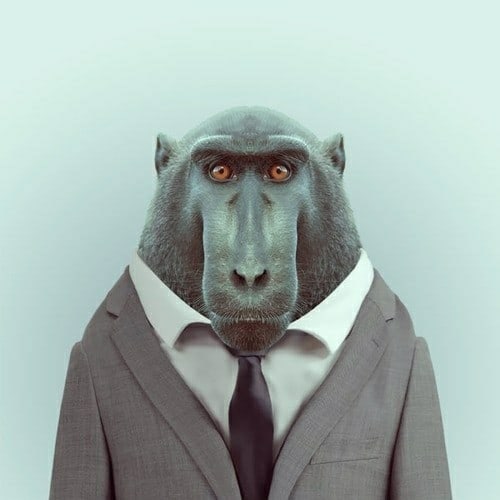
The photo shows a monkey against a light-blue background: a dark-gray face, orange eyes, pointed ears, a white shirt, a gray suit jacket, and a dark tie. The gaze is direct and a little tired. The lighting and composition look studio-grade, like a corporate headshot.
There's no caption on the picture itself. It's a template for any caption, but it's most often paired with the single word "robert."
What's known about its origin
Stylistically, the shot resembles the "Zoo Portraits" series by Barcelona photographer and director Yago Partal, who combines animal heads with clothing and human figures in collages, giving each one its own character. The series began as an advertising project and later grew into a standalone body of work. There's no confirmation that this particular shot comes from it, so that attribution is plausible but not proven.
The name "robert" itself also has no clear backstory. The meme is described as post-ironic and dated to roughly 2020, but the first post using this name hasn't been established. There's no point inventing a backstory for the character: the monkey in the photo has no known name, and "Robert" is simply a joke.
Why it's funny
Post-irony thrives on the absence of meaning. There are three layers here: the solemn face, the business attire, and the mundane name. The caption explains nothing, and the viewer decides for themselves what's funny about it. For some it's the contrast between a wild animal and office dress code; for others it's the very idea that a monkey could be given such a mundane name.
Another device is anthropomorphizing: the monkey looks like a person worn out at work. That's where scenarios about managers, bosses, and coworkers come from.
Why animals in suits work
Pictures of animals in clothing have long had a life of their own online: a human suit on an animal instantly reads as satire of office culture. A solemn stare makes the joke land harder than a smile would, because we're used to seeing such a suit on a person who isn't allowed to show emotion.
When such a portrait gets a single word attached to it, the result is a genre close to an absurdist statement: not a joke with a punchline, but a strange assertion you're invited to simply accept.
Example captions
"robert." The bare minimum of words turns the shot into a character portrait and makes it self-sufficient.
"When they say at the meeting that this could've been handled by email." The look in the photo reads as a silent "seriously?"
"My boss when I asked for vacation during peak season." The business suit works as a hint at seniority.
"robert already knows the deadline got pushed, and it changes nothing." The name comes back as a recurring joke within the joke.
Recommendations
What looks best is either a short, one-word caption or an office scenario. Long text breaks the effect, because the picture's strength lies in its emptiness. If you need a series of jokes, keep the name unchanged, and the meme stays recognizable.
Post-irony and endless variations
In post-ironic humor, what matters isn't the punchline but the feeling that the joke can be repeated for no particular reason. That's why "robert" doesn't need to change: it's enough to repeat it in different chats and discussions. Each new appearance adds to the feeling that this monkey is becoming part of the group.
Memes like this fall out of fashion quickly and come back just as quickly, because they're not tied to any particular event. Their staying power rests on the picture's strange aesthetic.