What the photo shows
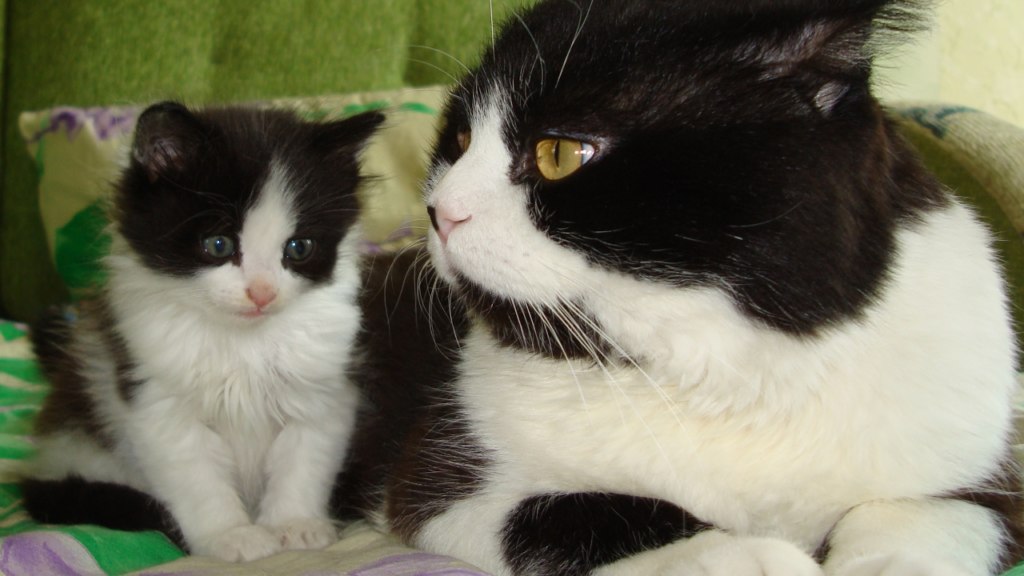
The photo shows two black-and-white cats on a patterned green blanket. On the left sits a tiny fluffy kitten with blue eyes and a pink nose. On the right, closer to the camera, is an adult cat with yellow eyes, looking off to the side, past the kitten.
The framing suits a dialogue: the adult "asks the question" or "listens to the answer", while the little one looks as if it has just been asked to explain its own existence. There are no captions on the image itself; it is a plain template.
The idea behind the format
The meme works as a dialogue. The older animal (a cat, a dog, any adult animal) demands: "Explain your smolness." The little one answers absurdly and very seriously: "I'm a potato," or names some other food. The Russian line is modeled on the English "explain your smolness", where "smol" means "tiny and adorable".
The word "smol" has been around the internet since 2015, and a whole family of "cute" jokes about small animals grew up around it. Who first posted this exact dialogue, and on which platform, is not known for sure: similar pictures are everywhere, and early examples cannot be told apart from later ones.
Why it is so endearing
First, the question sounds like a stern reprimand: "explain" demands an answer. Second, the answer runs on childlike logic: food is small, so the animal must be too. Third, the caption makes the viewer see the animal as a personality with its own opinion.
Besides, the format leaves room to play: the food can be swapped. Today it's a potato, tomorrow a dumpling (a Russian pelmen), a bun, or a lonely pea.
Caption examples
Above the adult cat: "Explain your smolness." Above the kitten: "I'm a potato, not a cat. Don't confuse me." The absurdity is that the kitten denies its own species.
"Why are you so small?" "I'm a dumpling, they haven't finished cooking me." Everyday food makes the answer funny.
"Are you sure you're a cat?" "No, I'm a bun. Just with eyes." The joke works through an unexpected clarification.
"So where's your height?" "I ate it." A shift in logic: the little one pretends its height was food.
How to use it
The format works best for photos where the difference in size is obvious. Keep the adult's line short and stern, and the little one's answer naive. Don't add long jokes: the point is the contrast between a formal question and an innocent answer. If you like the image but the caption doesn't work, swap the food: that is what delivers the surprise.
Where it fits among cute memes
The format belongs to the same family as the "smol" captions: little creatures and large animals are described as funny beings with their own character. What makes it funny is not an event but the voice the animal "speaks" in. A two-line dialogue works for puppies, hamsters and chicks alike, and the picture can be swapped without changing the text.
It's good to choose photos where the characters' gazes point in different directions: it looks as if they are addressing each other or pointedly ignoring each other. In this shot the adult cat looks past the kitten, which heightens the scene: the question is asked sternly and without extra emotion.