A white cat from the LOLcat era
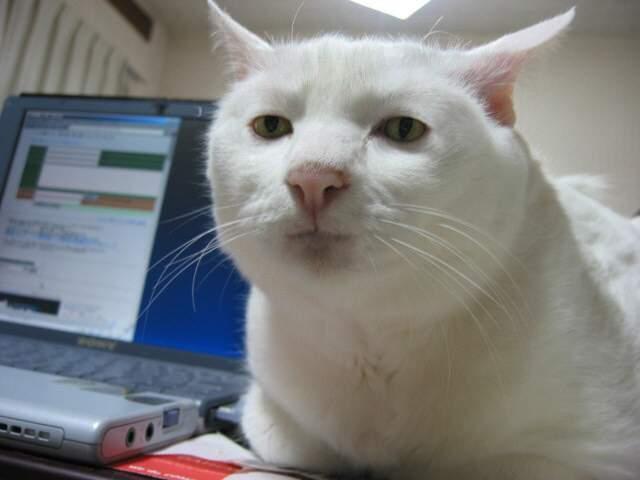
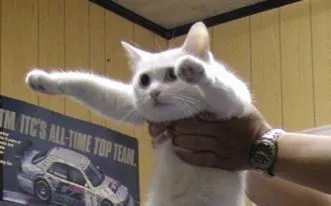
The name Serious Cat unites several cat images. An early photo of a white cat is linked to a Japanese photo board from 2003; an edited comparison with the rapper Jae Young is known from Humor University around 2005. By 2006 the caption “I are serious cat. This is serious thread” was circulating. The picture here is a different photograph: the BusinessCat shot with a laptop was taken by Paulo Ordoveza and published on September 7, 2006. Later this frame was also used for Serious Cat macros, but it cannot be considered the same photo as the one from the 2003 history.
In the photo, the cat sits in front of an open laptop and looks straight into the camera; the screen and keyboard give it a businesslike setting. The series also had the formula “I are serious cat, please you step into my office now”: it turned the stern cat into the owner of an office. That caption is not present here. The laptop lets one read a similar role without a literal quote, while a new caption, for example in Russian, can separately set up a work conversation or a request to stop joking.
A joke in a dry tone
The meme does not depict bright anger. Its comic force lies in the complete absence of a smile and in the sense that the cat seems ready to hand down a final verdict. So the caption often concerns a trifle that the hero suddenly declares a matter of principle: an argument over a semicolon, the order of cups on a shelf, the correct name of a folder. The reader sees the mismatch between a serene subject and a deliberately official reaction.
But the same frame can depict not only a pedant. The cat can be read as someone tired of noise, or as an expert finally about to answer to the point. No specific text is built into this photo, so the meaning is set by the caption. This makes it especially flexible: it doesn't impose a plot but supplies a character with a stable manner.
Invented captions
The examples are invented. “Please don't name the file ‘new_final_definitely2’” turns order into a matter of state importance. “In this board game we'll first finish reading the rules, and only then argue about who cheated” shows the cat as a moderator. “Who put a mug on my printed diagrams?” makes it a stern boss, even though the subject of the quarrel is ridiculous and harmless.
In a different mood, you don't have to invent a line; you can give a dry observation instead: “The meeting started at 10:00. The cat arrived on time.” Here the picture itself stands in for a person and gives the phrase an official air. The lack of words on the original image leaves room for such a short exchange — better not to overload it with a long biography of the character.
The laptop gives the role a new setting
The screen and keyboard add a concrete setting to the cat's stare. The sternness can already be explained by work: the character seems to be checking a document, waiting for an answer, or has put down a seal to talk. Unlike a portrait on an empty background, this photo leaves an activity beside it that a person easily recognizes. So the caption can say something not only about seriousness but also about the discussion interrupting an everyday task.
At the same time, the cat is not dressed in a suit or sitting at a real negotiating table. The businesslike role is created by the pairing of animal and computer, not by a literal meeting scene. A gentle comic gap persists between the domestic look and the official line: an ordinary pet suddenly gets the authority of an interlocutor waiting for a precise answer.