A photo with an unusual pose
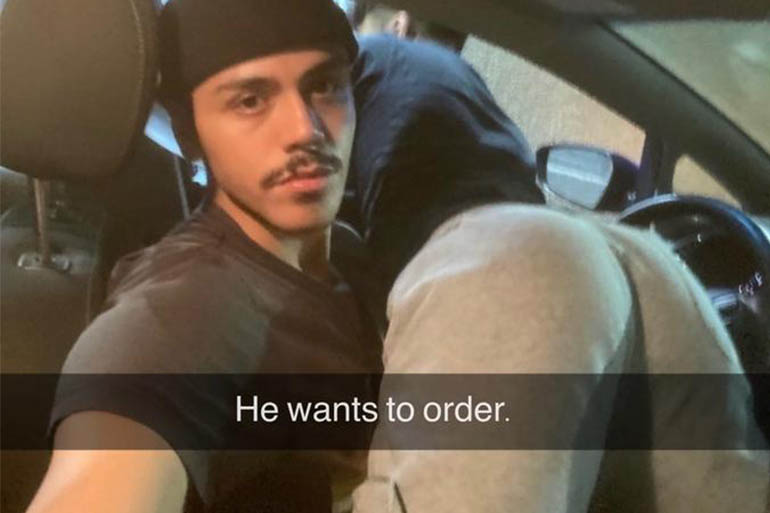
The original meme photo has survived: the driver looks at the camera while his companion leans across him toward the window and sticks his head outside. An English caption, "He wants to order," is already placed over the shot. Posts about the meme's spread link the photo to ordering at a drive-through, but what exactly the passenger wanted to order hasn't been reliably established.
It's important not to confuse the photo with a staged movie shot or a restaurant ad: there's no confirmation of either. The original photo took on a life of its own thanks to the composition itself — it looks like a thoroughly excessive way to place an ordinary order. The photographer and the exact circumstances of its creation are unknown, so no specific people or location are named as established fact.
Why redraws appeared
The image has an easily readable simple sequence: there's a driver, there's a person with a specific goal, and he's willing to occupy any amount of space to get what he wants. Meanwhile the driver's face stays almost unshaken, creating a second reaction — "I'm used to this." The gap between how hard the passenger is willing to stretch toward the order window and how ordinary the actual goal — placing an order — is makes the scene funny.
Users then started replacing the participants with drawings, game characters, and show characters. In the new versions the relationship between them changes, but the composition stays recognizable: one shows excessive determination, the other unwittingly becomes a witness to it. Some variants add flirtation or ambiguity; these are editors' interpretations, not a proven context for the original photo.
Examples of use
"He wants to order a coffee with syrup, but the barista has already closed the window." The caption makes the reaction disproportionate to the drink. "When you said you'd pick up the package yourself, and the courier called from the next entrance." Here the person is willing to lean across everything rather than change the plan.
For a friendly version this works: "I'm explaining to a friend where the charger is while he's sitting right next to the outlet." The driver's flat gaze can play the role of a calm observer long used to someone else's theatrics. These are new examples, not captions from the original post. You can change the object being ordered but should keep the clear contrast: a simple task and a physically excessive effort.
The English phrase is deliberately flat and literal. It describes the action but doesn't explain why the person took that position or how the driver reacts to it. It's exactly that lack of explanation that leaves room for redraws: a new pair of characters can turn the original gesture into caring, rivalry, awkward flirting, or simply excessive eagerness to grab a snack.
Tips for your own version
In the original, the caption is already placed across the bottom of the image. For a new caption, keep the driver's eyes and the passenger's position visible: without them the reactive pair loses its effect. A short phrase usually works better than a long explanation, and a redraw lets you convey the action without reusing the real participants' faces.
Keep in mind the pose can look intimate or awkward, and don't attribute a relationship or sexual intent to the people as fact. If you're making a fan redraw, it helps to signal that it's your own take on the scene. The template suits a desire to "reach" something, place an order, or butt into a conversation. The more specific the goal and the calmer the second character's reaction, the clearer the comic effect.