Two panels in the subway car
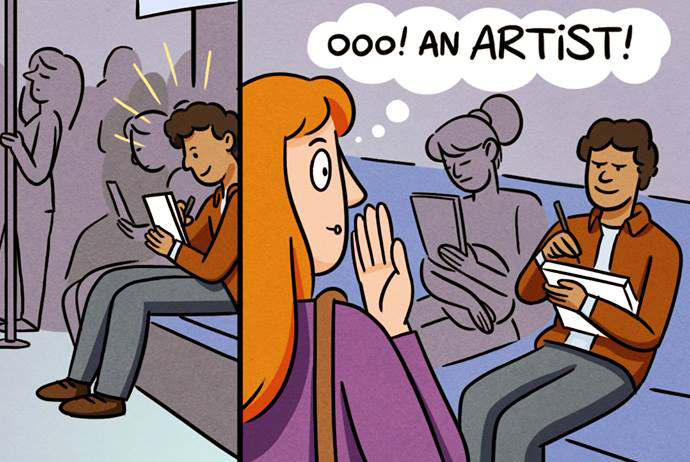
The image is divided by a vertical line. On the left, a young man with dark curly hair, wearing an orange-brown jacket, gray trousers, and brown boots, sits in a subway car. He holds a sketchbook and pencil on his knee, smiles slightly, and is completely absorbed in the drawing. Around him, the silhouettes of other passengers, including a woman by the handrail and the figures sitting nearby, are drawn in muted gray-lilac, so only the main characters remain in color. Near the head of one of the figures are short yellow strokes that emphasize that something noticeable has happened at that spot.
On the right, the same scene is shown from the girl's point of view. She has long red hair, a purple sweater, and a bag strap on her shoulder. One palm is raised to her face, and her eyes are wide open. Above her head is a thought bubble containing “ooo! an ARTiST!”. It is a thought bubble, not a line spoken aloud: the heroine is not addressing her neighbor but experiencing the discovery silently. The young man in this panel is still calmly drawing, while behind him on the bench sits a gray figure holding a flat object.
What is known about the origin
The author of the comic and the date of first publication are unknown: they cannot be established from the picture itself, and there is no confirmation of the original source. There is no artist's signature or watermark on the image, so any claims about authorship remain speculation. It is also unknown what the rest of the story looks like: the frame contains only two panels, and what happens next remains outside the image.
The artwork is soft, with flat color fills and warm tones. Such drawings read well even at small sizes, so the panels are easy to cut out and share separately from the rest of the comic. This is usually how they appear: as a ready-made template to which everyone adds their own caption.
Why the joke works
The exclamation “ooo! an ARTiST!” turns an ordinary passenger into an event. The heroine reacts as if she had seen a celebrity or a rare animal, while the situation is entirely mundane: a person is riding the subway and making a sketch. The main engine of the joke is the gap between the scale of the reaction and the scale of the occasion.
There is a second layer. The gray passengers are pushed into the background and look indifferent, so the viewer sees the situation almost from the outside: one enthusiastic girl and one calm neighbor. The actual outcome is not shown in the frame, and the viewer completes it on their own. This gives the picture its universality: the enthusiasm can be transferred to any object or activity.
Captions that work on this template
Three caption variants. Each relies on the same gap between the heroine's excitement and the ordinariness of what is happening.
“A colleague opened the expense spreadsheet, and to her it looks like he's creating a masterpiece.” The excitement is transferred to a dull object, and the difference between a spreadsheet and a masterpiece produces the joke.
“The neighbor on the subway is drawing a cat, and she's already picturing the exhibition.” The heroine seems to know what will happen next, and her certainty is exaggerated, which makes it funny.
“I saw someone writing something in a notebook and already decided: a future writer is sitting next to me. Although it's quite possible it's just a shopping list.” The excitement comes before the evidence, and that is the essence of the template: an incidental detail instantly turns into a loud title.
How to use the template
The frame suits stories in which someone unexpectedly showed talent or a hobby: knitting, playing guitar, solving a hard puzzle while waiting in line. The more specific the object of excitement, the better the caption works.
Do not turn the template into mockery of real people who sit on transport with a sketchbook. The caption should describe the activity and the heroine's feeling, not the neighbor's appearance or inner state. In the picture the young man looks content, and the joke should not break that impression.