a black-and-white close-up face
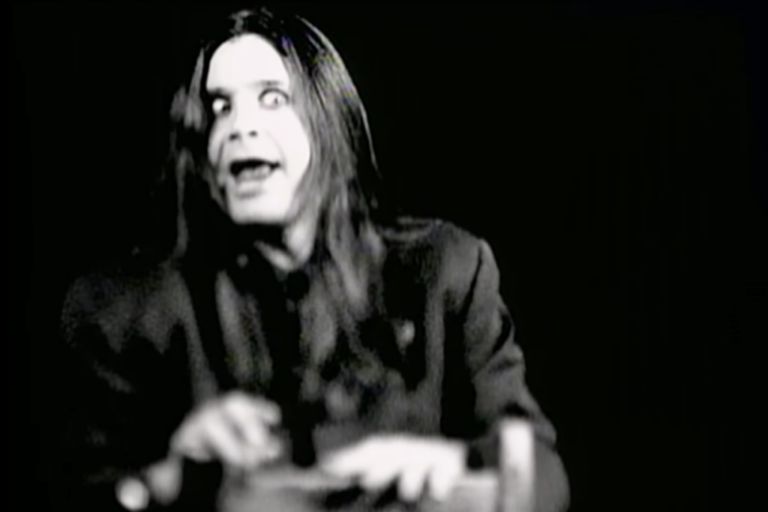
The image is black and white, shot in close-up. Ozzy Osbourne, long-haired, eyes wide open, mouth open — a moment of singing at full intensity, tension visible across his whole face. He wears a dark jacket, the background is almost black, and at the bottom of the frame a microphone stand can just be made out.
The frame looks like it was cut straight from a live-performance recording: no captions, no effects. The face functions as a sign of loud sound — it's enough for the viewer to mentally hear the song.
the line about grieving and hating to say goodbye
The basis is a fragment of the song "See You on the Other Side," which came out in 1995 on the album Ozzmosis. The lyrics are in English, and they include a line about grieving and hating to say goodbye.
In early January 2026, in the Ukrainian-language segment of short videos, listeners began hearing in the word "grieving" the word "hryvnia" — the name of the Ukrainian currency. From there the trend moved into the Russian-language segment, and other words started being "heard." The song itself contains none of these words: they arise only in perception.
mondegreen: why you hear what isn't there
This is the hearing apparatus at work. A person is constantly searching for familiar words within unfamiliar sounds, and this happens on its own, without effort. The effect is called a mondegreen: a foreign language breaks apart to the ear into fragments of one's native speech.
What gets heard is always something of one's own, something close: words from everyday speech, not a random jumble of sounds. That's why the meme makes sense to those who know the language the song "sounds like" — for everyone else it's just noise. Anyone who has ever heard their own name in someone else's foreign speech knows this same effect.
Confidence then kicks in. The more insistently a person repeats that this is exactly what they hear, the funnier it gets: the viewer checks for themselves and almost always starts hearing the same thing.
a dictionary of heard words
The wave grew noticeable enough that in April 2026 a dedicated dictionary came out — "The Russian Meme Dictionary of an Ozzy Osbourne Song." The author collected, under one cover, the English words from the song alongside what they sound like in Russian.
This format suits the meme best of all: the value here isn't in a single joke but in a list of coincidences that anyone can check for themselves. One song produced enough material for an entire collection of "translations."
how the clips are built
The format is simple: a fragment of the music video is taken and inserted so that it looks as if Ozzy is answering a person's line. Publications about the meme cite an example like this: to the question "How much does it cost?" the song appears to answer "hryvnia…"
Sometimes one heard phrase is enough to build an entire scene around it. The date the meme appeared and the author of the first clips are not established: publications describe only the mechanism, not the original creator.
captions playing on the mondegreen effect
"Asked how much the course costs. She answered: hryvnia." The caption plays on the mechanism itself: the fragment is inserted as the answer.
"Put the track on in the background — and it immediately butted in with an answer: hryvnia." Here the joke is built on the song's unexpected participation in an everyday scene.
"Listened to this as just a song for twenty years, and now I hear 'hryvnia' in every other word." A version about how the heard phrase arrives suddenly and then never goes away.