What's in the picture
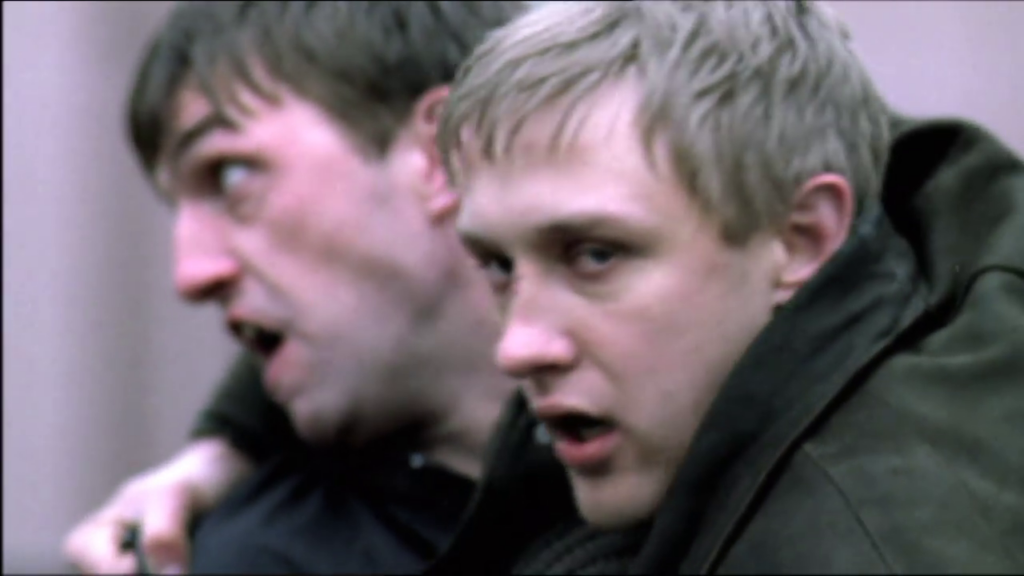
The frame shows two young men in dark clothing standing almost right next to each other. Both are looking to the side, their faces twisted with fear and tension. The blond man on the right has his mouth slightly open, as if he's just screamed, while the second character on the left has turned his head sharply, as if reacting to something. The background is blurred and bright, and the picture is grainy, with the muted color palette typical of early-2000s cinema.
This exact frame serves as the meme's visual anchor. The viewer instantly reads the emotion of extreme tension, and the caption "Dimooon!" signals that this is a drawn-out scream, not an ordinary line. The shot works like a jump scare: a sharp shift from a calm state to a breakdown, which looks comic precisely because of how serious it is in form.
The frame itself doesn't require knowledge of the plot to be funny. The meme rests on the intonation and on the recognizability of the scene, which many remember from the film or from clips of it. So even someone who's never seen the movie easily grasps the general sense: something sudden and loud is happening.
Origin and history
"Boomer" is a 2003 Russian crime action film directed by Pyotr Buslov, about three friends who return from the army and get drawn into dangerous criminal entanglements. The film became one of the notable phenomena of early-2000s Russian cinema, and its lines and scenes were repeated in everyday speech and parodies for a long time afterward. The film's final episode ends with one of the characters screaming out, calling the name Dima. This cry is what became the source of the meme.
The meme gained popularity in August 2017, when a short edit of the scene spread across social media as a jump scare. It hasn't been possible to establish the exact author of the first edit, or the first post that kicked off the viral surge, so this part of the origin remains unclear. All that's known is that it was precisely in 2017 that the cry broke away from the plot and started living a life of its own.
It's worth noting that in the film itself, the scream is delivered in a dramatic context, tied to the tragedy and tension of the ending. Online, though, it was taken out of the storyline and turned into a standalone reaction, stripped of its original meaning. This shift from drama to comedy is typical of many Russian film memes, where any memorable scene can become a joke.
How the meme is used
The typical use of the meme is as a response to unexpected news, a loud sound, or a sudden event. The frame gets dropped into chats, comments, or feeds, and the text usually boils down to the name "Dimooon" with a drawn-out ending and exclamation marks. Sometimes the caption is supplemented with a description of a situation that the user finds overly dramatic for its scale.
The meme is also used as a jump scare in videos and GIFs: a sound or frame pops up suddenly, after a pause, matching the scene's original function in the film. This kind of use is especially common in short videos, where a quick emotional shift and the element of surprise matter most.
There's also an ironic use, where a perfectly ordinary situation is framed as a catastrophe. For example, a user might react this way to a delayed delivery, bad weather, or an unpleasant message in a chat app. The greater the contrast between the trigger and the scream, the stronger the comic effect.
Why the meme caught on
The main reason for its popularity is the contrast between a serious film and a comic reaction. "Boomer" became a cult classic in the 2000s, and many viewers knew its intonations and lines by heart, so recognition is instant. When the audience understands which film the frame is from, the joke lands even harder: it's both about the reaction and about the shared cultural code.
The second factor is the simplicity of the form. The character's name is easy to repeat, and the scream stretches out syllable by syllable, which makes it easy to voice and imitate. The meme doesn't require an elaborate caption or lengthy context, so it's easy to use in quick replies in chats.
Finally, the meme fits the internet users' habit of lifting emotional film frames out as universal reactions. This practice emerged long before 2017 and continues to work: the viewer recognizes the scene, remembers the film, and gets a sense of shared cultural experience. That's exactly why "Dimooon" remains recognizable even years after its first wave of popularity.