Conversation on CONAN
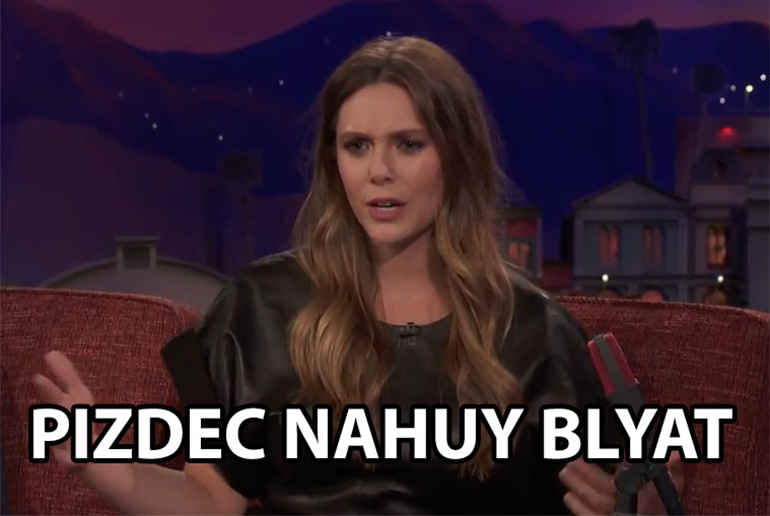
The official CONAN clip with Elizabeth Olsen was published on September 18, 2018. Conan O’Brien asks her about Russian, and the conversation turns to the curse words she picked up during a semester of study in Russia. Olsen explains individual words and combines them into an emotional phrase. Later this short fragment began to be republished separately from the interview. In the clip itself, the explanation of meanings gives way to saying them aloud; the meme keeps only the brief burst of language from that exchange.
A large Latin-script caption has already been placed over the frame. Olsen sits on a couch gesturing, her speech directed at the host. The sharp expression belongs to the scene of a TV talk, but the meme caption isolates only the short phrase and turns it into a ready-made reaction that needs no knowledge of the whole conversation.
From line to reaction
When the fragment is separated from the interview, the foreground is taken not by a story about a trip but by intonation. The short combination of profanities sounds like a universal outburst of emotion: something suddenly broke, proved absurd, or exceeded expectations. The caption itself is already harsh, so the new context is often built on the contrast between an everyday situation and an overly strong response.
At the same time, the original episode remains an interview with an actress, not a statement about anyone’s qualities or views. The conversation leads to humor precisely through linguistic surprise: the viewer hears Russian profanity on an American late-night show and sees the reaction of the people talking. In meme use, the frame becomes a brief emotional pause before an explanation of what caused the surprise.
Why the sharp contrast works
The large caption occupies almost the entire lower part of the image, so it is read before one has a chance to reconstruct the context of the couch and the microphone. The Latin letters approximate the Russian phrase and make it noticeable even to people who do not know Cyrillic. As a result the meme is perceived at once as a sound, a visual sign, and a cultural surprise, rather than simply as a photo of a celebrity.
A strong profane formulation is especially fitting for an event that breaks the usual order: an unexpected plot twist, a strange instruction, or a result that does not match the calculation. If the trigger is very minor, deliberate exaggeration becomes part of the joke. For example, a caption can turn a sudden coffee spill into the finale of a tense thriller; the TV scene supplies such a jump with ready-made facial expressions and gesture.
Invented captions
Invented example: “After the laundry, the socks of one pair came out different colors.” The gap between a calm everyday task and a strange result gives a clear reason for an excessive reaction; the caption turns a small but real glitch into a catastrophe scene.
Another variant: “You open a document after saving and the formatting has jumped to the next page.” Here the frame becomes a reaction to the moment when technology unexpectedly complicates a simple task. A strong phrase replaces a long explanation of irritation, and the situation itself stays understandable without reference to other lines by Olsen or to her personal life.